In boardrooms across industries, one assumption continues to undermine resilience quietly:
“If we have an incident response plan, we’re covered.”
You’re not.
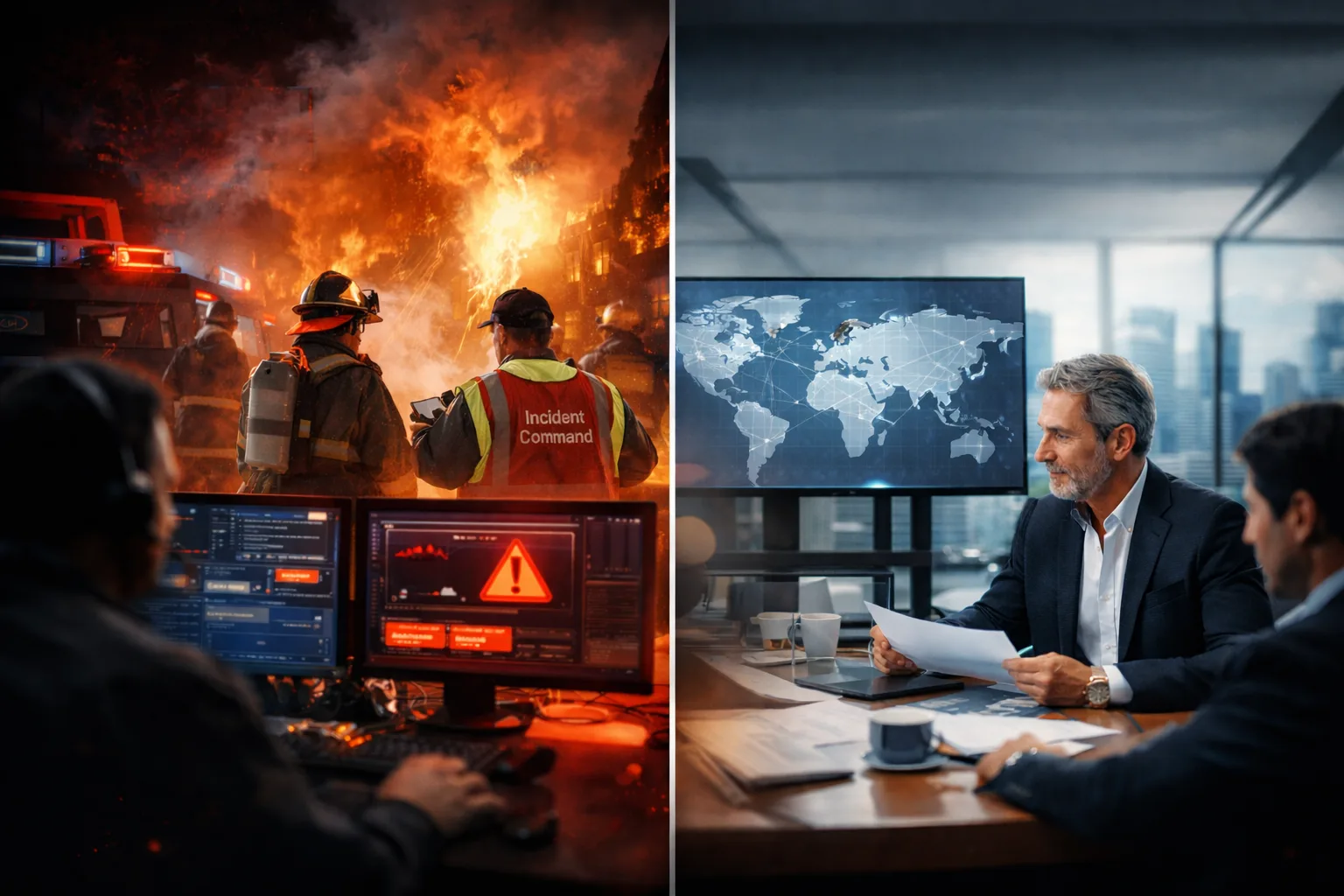
An incident response plan is about reacting. Continuity is about enduring.
They are not the same. And confusing them creates a dangerous blind spot—especially for organizations operating in high-risk, high-visibility, or high-value environments.
This is where many security and risk programs stall: they mistake movement for strategy.
Let’s interrupt that pattern.
The Illusion of Preparedness
Incident response plans are visible. Tangible. Documented.
They typically include:
- Notification trees
- Escalation protocols
- Crisis communications templates
- Forensic investigation workflows
- Regulatory reporting steps
These are necessary, but they answer only one question:
“What do we do when something goes wrong?”
Continuity answers a different question:
“How does the organization continue operating while something is going wrong?”
That distinction changes everything.
Response Is Reactive. Continuity Is Structural.
Incident response activates after a disruption.
Continuity is designed before disruption.
Response manages the event. Continuity protects the enterprise.
Response is episodic. Continuity is operational.
Most organizations invest heavily in response because disruption feels like a discrete event:
- A breach
- A protest
- A physical intrusion
- A reputational crisis
- A cyber compromise
- A threat against leadership
But modern risk is rarely discrete. It is layered. Converged. Cascading.
A physical incident becomes a digital vulnerability.
A cyber event becomes a reputational event.
A reputational event becomes a leadership exposure.
Without continuity architecture, response becomes damage control—not stability.
Why Response Plans ≠ Continuity
Let’s break the misconception down strategically.
1. Response Plans: Assume Operational Stability
Most incident response frameworks assume:
- Core systems are intact
- Leadership remains available
- Key vendors are operational
- Communications infrastructure works
But what happens when:
- A CEO is personally targeted and temporarily removed from operations?
- A data center disruption overlaps with a public-facing crisis?
- A physical access control failure coincides with a cyber compromise?
Response plans often treat these as isolated events.
Continuity planning treats them as simultaneous stressors.
2. Response Is Tactical. Continuity Is Executive-Level.
Incident response is often owned by:
- IT
- Security
- Legal
- Compliance
Continuity requires executive ownership.
Because continuity decisions involve:
- Succession authority
- Revenue prioritization
- Strategic tradeoffs
- Supply chain restructuring
- Operational redundancy
- Reputation preservation
These are not technical decisions. They are enterprise decisions.
When continuity is relegated to “disaster recovery binders,” it becomes symbolic—not functional.
3. Response Protects Assets. Continuity Protects Mission.
A breach response protects data.
A physical security response protects property.
A crisis communications response protects the narrative.
Continuity protects the organization’s ability to fulfill its mission under stress.
That is a fundamentally different objective.
The question shifts from:
“How do we contain this?”
to
“How do we remain stable while this unfolds?”
That’s strategy.
The Convergence Problem
Modern risk environments are not siloed. They are converged.
Physical, cyber, executive, and reputational risks overlap—often intentionally.
Consider scenarios where:
- Social media exposure reveals executive travel patterns.
- A protest escalates into a coordinated digital campaign.
- A vendor compromise disrupts both the supply chain and data integrity.
- Insider access misuse bridges physical and network environments.
An incident response plan may address each domain separately. Continuity integrates them.
Without integration, response teams may act efficiently—while the organization destabilizes quietly in parallel.
The Cost of Confusion
When leadership equates response with continuity, three predictable outcomes occur:
1. Overconfidence
The presence of binders and playbooks creates psychological comfort.
But comfort is not resilience.
2. Fragmentation
Each department prepares independently.
No one architect’s enterprise-wide endurance.
3. Delayed Escalation
Continuity decisions are made too late—because executives assume “the team is handling it.”
Response teams may handle the incident.
But who is protecting revenue continuity?
Who is preserving strategic positioning?
Who is safeguarding long-term trust?
What Real Continuity Looks Like
Continuity is not a document.
It is an operating philosophy embedded into enterprise design. It includes:
- Executive succession modeling under threat scenarios
- Distributed decision authority frameworks
- Redundant operational pathways
- Cross-domain security integration
- Vendor continuity audits
- Real-time risk intelligence alignment
- Leadership protection is tied directly to operational resilience
Continuity asks:
- If this disruption lasts 48 hours, what changes?
- If it lasts 30 days, what breaks?
- If it targets leadership specifically, what fails silently?
Those are not response questions.
They are endurance questions.
Leadership Exposure: The Overlooked Continuity Gap
One of the most overlooked continuity failures involves executive targeting.
High-visibility leadership creates asymmetric risk:
- Online doxing
- Coordinated harassment
- Insider leaks
- Travel exposure
- Protest escalation
Incident response may activate after a threat is detected.
Continuity planning anticipates what happens if leadership capacity is reduced or temporarily unavailable.
If your continuity model does not include an executive protection strategy, you are not continuity-ready.
You are response-ready.
And that difference matters when the threat is personal.
Strategic Pattern Interrupt: Ask the Hard Question
Instead of asking:
“Do we have an incident response plan?”
Ask:
“If our CEO, our primary revenue system, and our reputation were stressed simultaneously, could we operate without improvisation?”
If the answer requires hope—or heroics—you don’t have continuity. You have optimism.
Continuity Is Competitive Advantage
Organizations that are architected for continuity:
- Recover faster
- Retain stakeholder trust
- Preserve market positioning
- Maintain leadership credibility
- Reduce cascading losses
Continuity is not defensive. It is strategic insulation.
In volatile sectors—construction, infrastructure, public-facing leadership, finance, critical services—continuity design directly influences enterprise valuation.
Investors notice. Board’s notice. Adversaries notice.
The HKDS Position
At HK Defense Solutions, we operate from a simple principle:
Security without continuity is reactive.
Continuity without convergence is incomplete.
True resilience requires integrating:
- Executive protection
- Physical security
- Cyber awareness
- Operational redundancy
- Strategic risk advisory
Not as parallel tracks, but as a single operating architecture.
Because disruption is no longer linear. And your defenses shouldn’t be either.
The Bottom Line
Incident response is necessary. It is not sufficient.
If your organization defines preparedness by how well it reacts—instead of how well it endures—you are measuring the wrong metric.
Continuity is not what you do after the disruption.
It is how you remain stable during it.
And in today’s risk environment, that distinction is no longer theoretical.
It’s existential.