
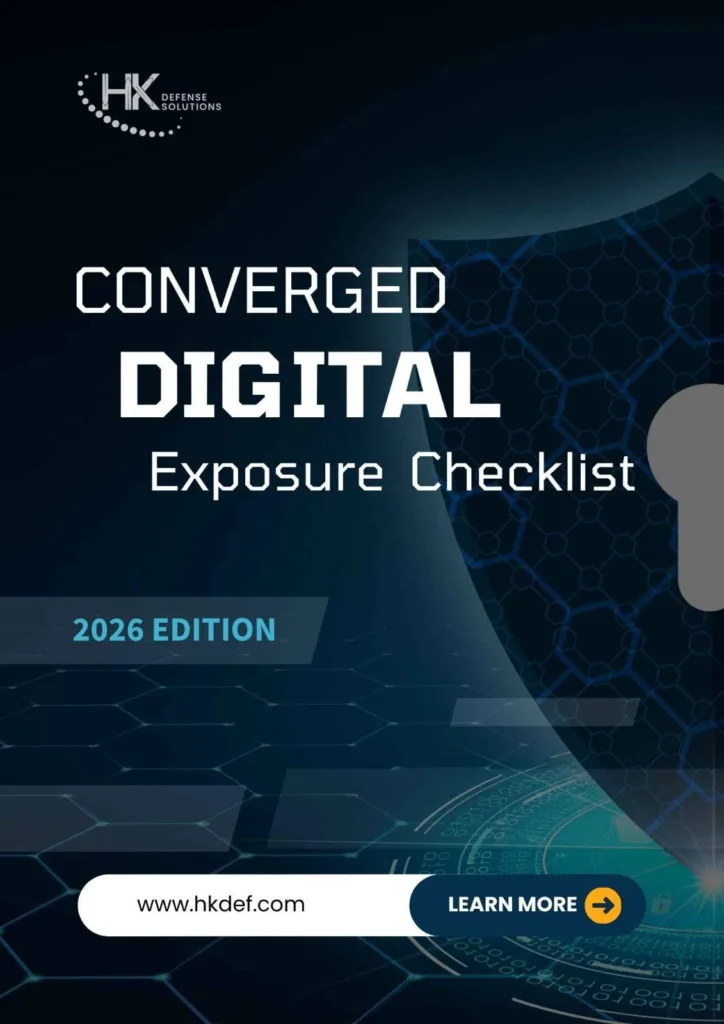
Converged Digital Exposure
Bridge the Gap Between Your Online Footprint and Physical Security
Find Your Digital Shadows
Step-by-step guide to auditing what an adversary could learn about you or your organization from public sources, social media, data brokers, and the dark web.
Personal Device Lockdown
Ensure your phones, laptops, and cloud accounts aren’t leaking sensitive info that could lead someone to your doorstep (remember Jeff Bezos’ phone breach).
Social-to-Physical Safety
Learn best practices for posting (or not posting) and how to instruct family/staff so that innocuous online shares don’t become security risks in real life.
Integrated Defense Tips
How to get your cyber team and executive protection/physical security team sharing intel about digital threats crossing into the physical realm.
Empowerment, Not Fear
A clear action plan that puts you back in control of your information. Free download, confidential results, take the first step to disappearing from attackers’ radar.
Download Your Free Checklist
When Online Clues Lead to Real-World Threats.
In today’s connected world, the walls between digital and physical have all but dissolved.
Take it from Jeff Bezos.
In 2018, a single WhatsApp message breached the private phone of the world’s richest man.
There was no break-in with ski masks, no server farm hack from afar.
It was a social connection exploited through a tiny app on a phone.
Within days, personal data that should have been utterly confidential splashed across global news.
The fallout was immediate: reputation damage, shareholder jitters, a very public lesson in converged security failure.
Experts later confirmed the attack could have been thwarted if Bezos had integrated his digital and physical security oversight – exactly the kind most companies and individuals still neglect.
Now, you may not be Bezos, but if you’re an influential individual or manage security for one, you must assume adversaries are scanning both your online presence and your offline world for weaknesses.
Maybe they’re criminals eyeing kidnapping or extortion.
Maybe corporate spies linking your LinkedIn activity to guess what projects you’re working on.
Maybe activists mapping executives’ home addresses from data broker info to stage protests.
We’ve seen all of this.
The question is, what might they see about you or your organization – and how might they use it?
The Digital-Physical Convergence
(Your New Security Perimeter)
Why Traditional Approaches Fail
Traditional security thinks in categories – IT handles hackers, Facilities handles badge access, Security guards handle doors, etc.
But modern threats cross those lines with ease.
“They cannot stop what they cannot see together,” John Hamilton reminds us.
If a cyber team sees chatter about an employee on the dark web, does anyone tip off physical security that that employee might be targeted in person?
Or if EP (executive protection) notes a suspicious person hanging around the office lobby day after day, does IT get alerted to watch that person’s online behavior or attempted logins?
Often, no. That’s the gap converged security fills.
HKDS Founder’s Insight on Digital Exposure
John Hamilton built HKDS precisely to address these seams.
He points out that “today’s threats aren’t just physical. They’re digital, persistent, and often invisible until it’s too late”.
Adversaries now “pull data from brokers, exploit network vulnerabilities, and comb leaked information to map where you are, where you’re going, and who you’re with”.
That chilling description is exactly what our Converged Digital Exposure Checklist helps guard against.
John likes to share a mantra from his military days:
“If you have to react, you’re already late.”
In the converged world, that means if you’re responding to an attack that has already bridged your digital and physical, you’ve missed multiple chances to stop it earlier.
We want you to catch it at the earliest digital hint.
Real Fortune 500 Protection Story
One HKDS case highlights this well: A Fortune 500 CEO started getting bizarre, vaguely threatening tweets directed at him. The company’s social media team shrugged it off at first.
Weeks later, someone attempted to tailgate into the CEO’s gated community.
Our intelligence analysts connected the dots – the Twitter user had also posted the CEO’s home address (from public records) and discussed “seeing him soon.”
We quickly stepped in: tightened residence security, worked with Twitter and law enforcement to handle the individual, and concurrently ran a scrub of the CEO’s online exposure.
We found his personal email and cell were in a prior data breach dump, and his family members had public social profiles revealing routine patterns. We helped lock all that down. The would-be attacker was thwarted on arrival (arrested at the gate, actually), and because the CEO took action promptly, that threat did not escalate or inspire copycats.
How to Use the Converged Digital Exposure Checklist
This checklist is an eye-opener. Be ready to discover information about yourself that’s floating out there.
We guide you through:
Self-Search and Data Audit
Play the adversary for a moment, Google yourself, check data broker sites, and see what’s publicly available. Many are surprised by what they find. The checklist guides you through where to look and how to start removing that data — an ongoing effort, but every step strengthens your privacy.
Device and Account Security
Mini tech audit: Is your phone encrypted and updated, do key accounts use MFA, and have you stripped metadata from photos? Simple digital hygiene like this can stop hackers from turning online clues into a real-world break-in.
Info Sharing Practices
This is where you assess how you and your inner circle share information. Do you post travel plans publicly or let assistants send itineraries without NDAs? Does your company share team photos that reveal everyone’s location? These examples highlight why you need policies like time-delayed posting and need-to-know information sharing.
Integration Questions
It all comes down to integration.
Are your IT and physical security teams sharing intel?
Does your executive protection team see cyber threat reports about you — and vice versa?
If not, start regular convergence briefings. Even as a private individual, ensure your cybersecurity expert and home security provider coordinate.
Converged Security = Peace of Mind
The ultimate goal is not to make you paranoid, but to empower you. When you reduce your digital footprint and integrate your defenses, something amazing happens: threats that would have blindsided you either become non-issues or at worst, minor bumps handled with routine.
You go from worrying about “what if” to knowing you’ve done what’s necessary. You can use technology and live your life without feeling exposed.
Get the Converged Digital Exposure Checklist
Enter your name and email to instantly download the Converged Digital Exposure Checklist — a concise, battle-tested tool from HKDS’s frontline experience. Many clients say completing it was transformative. Don’t wait for a doxxing, phishing scare, or real-world threat to force action.
This checklist is free, confidential, and for your eyes only. Take control of your digital and physical safety now.