
Choosing a superyacht security solutions provider is one of the most consequential decisions a UHNW owner will make. The yacht is simultaneously a residence, a vehicle, a status asset, and a moving target. It sits in waters where jurisdiction shifts every few nautical miles, and it is crewed by people who come aboard for a season and leave with institutional knowledge about the owner’s family, routines, and vulnerabilities.
HK Defense Solutions serves as a superyacht security solutions provider for owners operating in Florida, the Caribbean, the Mediterranean, and transit routes in between. This article explains what a real superyacht security solutions provider delivers, where most providers fall short, and what owners and captains should be asking before they sign a contract.
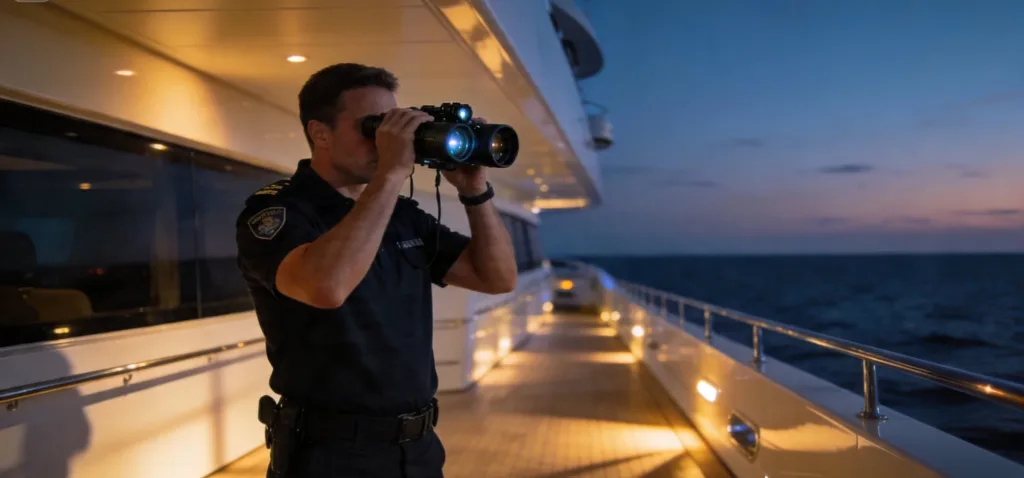
What a Superyacht Security Solutions Provider Actually Does
The right superyacht security solutions provider delivers an integrated capability that covers physical security aboard the vessel, cyber and communications integrity for the owner and guests, crew vetting and behavioral oversight, advance work at port calls, and crisis response planning for a range of maritime scenarios.
That is not what most providers in the market deliver. Most yacht security offerings are one of three things: a kinetic team of ex-military operators on board during transit through high-risk waters, a technology stack of cameras and alarms with no human component, or a crew-level security officer with limited authority and no integration with the owner’s broader protection program.
Each of those offerings addresses one piece of the problem. None of them addresses the full picture. A superyacht security solutions provider worth hiring integrates all three, plus the protective intelligence and cyber components that most owners do not think about until a breach has already occurred.
The Threat Environment Facing Modern Superyachts
The threats facing superyachts in 2026 have evolved well beyond piracy. Kinetic attacks in transit waters remain a risk in specific corridors, but they are no longer the primary category of incident for most owners. The more common threats are digital, reputational, and insider.
Crew members post photos of the yacht to social media, revealing its location, schedule, and interior layout. Port staff photograph guests. Data brokers aggregate vessel registration, ownership records, and movement patterns into publicly available profiles. Credential exposure from crew personal devices exposes the yacht’s network. Deepfake communications impersonating the owner direct the captain to unauthorized actions. Social engineering targets the crew to gain access to the vessel during port calls.
A superyacht security solutions provider operating in 2026 has to cover all of these categories. A provider that only thinks about kinetic threats is solving the 2005 problem and leaving the 2026 problem uncovered.
Crew Vetting and Behavioral Oversight
The crew is the largest single security variable on any superyacht. Most incidents affecting yacht owners involve crew action, whether malicious, negligent, or simply uninformed. A strong superyacht security solutions provider builds crew vetting and ongoing behavioral oversight into the program as a foundational layer.
Vetting goes beyond background checks. It includes verification of work history, reference contacts with previous captains, social media footprint review, and behavioral indicators that may suggest risk. Ongoing oversight means monitoring crew behavior during the engagement, not just at the hire date. Staff who begin showing signs of financial stress, personal crisis, or unusual communication patterns are flagged early, before those signs become incidents.
This function has to be delivered with discretion. Crew members are not suspects. They are professionals operating in close quarters with the owner and family. A superyacht security solutions provider that treats crew monitoring as surveillance will destroy the working environment aboard. Done correctly, it preserves the environment while catching the rare cases where something is wrong.
Cyber and Communications Integrity
Superyachts are floating data centers. They carry the owner’s personal devices, guest devices, yacht management systems, navigation and engine controls, satellite communications, crew personal devices, and entertainment systems. Any of these can be a vector for compromise.
A superyacht security solutions provider worth the title maintains a cyber and communications integrity program that covers all of them. That includes network segmentation between guest, crew, and operational systems, device hygiene standards for anything connecting to the yacht network, credential monitoring for all persons aboard, and secure communications protocols for owner and family use.
Without this layer, the yacht’s physical security program is operating with a hole in its side. An attacker who compromises the owner’s email from shore knows the guest list, the itinerary, and the security posture before the yacht arrives anywhere. Physical security cannot compensate for that level of exposure.
Port Calls and Advance Work
Every port call is a security event. The yacht transitions from a controlled environment at sea to an uncontrolled environment alongside a dock, with local staff, vendors, customs officials, and curious onlookers moving through the perimeter. The vessel’s security posture during port calls is where most incidents form.
A capable superyacht security solutions provider runs advance work at each port call. An advance agent contacts local port authorities, assesses the dock environment, identifies threat indicators, coordinates with any receiving protective teams for the owner and guests, and briefs the yacht security officer on what to expect. This is not optional. Port calls without advance work are where yachts lose control of their perimeter.
Maritime Crisis Response
Crisis response aboard a superyacht is a specialized discipline. The vessel may be hours from the nearest medical facility, days from a friendly port, and in jurisdictions where local law enforcement support is unreliable. The response team has to be prepared to handle medical emergencies, kinetic incidents, fire, flooding, and psychological crises with the resources already aboard.
HK Defense Solutions integrates crisis response into every superyacht security engagement. The operators aboard are cross-trained in tactical medicine, firefighting coordination, and extraction planning. Response protocols are documented, rehearsed with the crew, and updated based on the vessel’s current itinerary.
The HKDS Standard
HK Defense Solutions operates as a superyacht security solutions provider for a limited number of owner clients at any given time. That limitation is deliberate. Delivering integrated security aboard a superyacht requires direct command relationships, detailed knowledge of the vessel, and a level of operational trust that cannot be scaled without dilution.
The HKDS engagement process for new yacht clients begins with a vessel-level threat assessment. John Hamilton, or a senior HKDS operator with maritime background, visits the vessel, interviews the captain and key crew, reviews existing security protocols, and produces a documented gap assessment. From there, the engagement is scoped to the specific needs of the owner and the operational profile of the vessel.
What Owners Should Ask
Owners and captains evaluating a superyacht security solutions provider should ask the following questions.
First, what is your approach to crew vetting and ongoing behavioral oversight? A real provider has a documented methodology. A marketing-driven firm will deflect.
Second, how do you integrate cyber and communications security with the physical program? A real provider treats these as one function. A fragmented provider will refer you to a cyber vendor.
Third, how do you handle port calls and advance work? A real provider does advance work as standard practice. A fragmented provider treats it as an add-on.
Fourth, who is the senior operator on the vessel during my engagement, and what is their background? A real provider can name the individual and describe their protective history. A fragmented provider will promise “a qualified team” without specificity.
Fifth, how do you integrate with my existing land-based protection program? A real provider treats the yacht as one layer of the owner’s overall security posture. A fragmented provider treats the yacht as a standalone engagement.
Next Steps
Owners, captains, and family office principals who want to evaluate their current yacht security posture can request a Private Threat Mapping Session with John Hamilton at hkdef.com. The session includes a review of the vessel’s current security program, cyber and communications integrity, crew vetting protocols, and crisis response readiness, and produces a documented recommendation for any gaps identified.
For a self-guided starting point, download the HKDS Converged Digital Exposure Checklist and the Board-Level Risk and Continuity Oversight Checklist from the downloads section of our website.
A superyacht security solutions provider is not a line item. It is the team you will rely on the day something goes wrong. Choose accordingly.
Regional Yacht Security Considerations
Superyacht security solutions differ significantly based on cruising grounds. Yachts operating primarily in the Caribbean and Bahamas face a different threat mix than yachts transiting the Mediterranean or crossing into international waters. A superyacht security solutions provider worth hiring understands each cruising ground at a working level.
In South Florida, many superyachts dock at Rybovich in West Palm Beach, Island Gardens in Miami, or the private facilities at Fisher Island. Onboard security needs to integrate with marina security, customs procedures, and crew transitions. The superyacht security solutions provider has to build programs that function at dock and underway, with different postures for each.
For yachts transiting to the Northeast for summer seasons in Newport, Nantucket, and the Hamptons, the security solutions provider has to maintain continuity across ports, guest rotations, and jurisdictional boundaries. Continuity is one of the most common failure modes in yacht security.
Frequently Asked Questions About Superyacht Security Solutions
Does my crew already handle security?
Most crews handle basic access control but lack protective intelligence, cyber defense, and threat assessment capability. A superyacht security solutions provider fills those gaps without replacing crew authority.
How is yacht cyber exposure actually attacked?
Through crew devices, guest devices, onboard WiFi, navigation systems, and satellite communications. A proper superyacht security solutions provider runs cyber assessments alongside physical security.
Should I have armed operators onboard?
In most cruising grounds, no. Armed postures create customs and jurisdictional problems that outweigh the marginal security benefit. There are specific exceptions for high-threat transits.
How do I integrate yacht security with my residential and executive protection programs?
Through a converged security provider. Fragmented providers across yacht, residence, and executive protection create intelligence gaps.
The HKDS Superyacht Security Model
HK Defense Solutions builds superyacht security solutions that integrate physical protection, protective intelligence, cyber defense, and crisis response under unified command. John Hamilton personally reviews yacht security programs for UHNW principals. Book a private threat mapping session at hkdef.com. Download the Board-Level Risk and Continuity Oversight Checklist and the Converged Digital Exposure Checklist.