Security crisis management is the moment when every assumption in a protection program gets tested. Either the plan works, or it does not. There is no middle outcome. For UHNW families, family offices, and corporate security directors operating in Florida, New York, and internationally, that moment is where providers earn or lose their position.
HK Defense Solutions builds security crisis management into every engagement as an operational discipline rather than a contingency document. This article explains what real security crisis management looks like, how converged response differs from traditional guard-service response, and what family offices and chiefs of staff should expect from their providers.
Defining Security Crisis Management
Security crisis management is the coordinated response to any event that threatens the safety, privacy, continuity, or reputation of a principal, family, or organization. It includes everything from a medical emergency on a principal’s yacht, to a stalker escalating at the family estate, to a deepfake extortion attempt targeting a CEO, to a credible kidnap threat against a family member overseas.
The common thread across all of these scenarios is that the response has to function under time pressure, incomplete information, and high stakes. Security crisis management is not a document. It is a capability that has to be rehearsed, updated, and executed by people who know each other and the principal’s environment.
Most security programs that advertise “crisis management” deliver a binder. The binder contains emergency contact lists, evacuation routes, and checklists. The binder is the low end of the discipline. It has value only if someone reads it, rehearses it, and updates it.
Why Converged Security Crisis Management Matters
Traditional security crisis management treats physical threats, cyber incidents, and reputational events as separate problems handled by separate teams. That model fails in 2026 because real crises rarely stay in one domain.
Consider a common scenario. A UHNW principal’s home address leaks through a data broker. An activist group identifies the address and begins organizing a protest. Two staff members post to personal social media referencing the principal’s schedule. A security incident that started as a digital exposure event is now a physical protection event within seventy-two hours.
Traditional providers would treat each of those steps as a separate problem. The cyber vendor would handle the data broker leak. The guard service would handle the protest. The PR firm would handle the social media. Nobody would see the full picture until the incident was fully formed and the principal was already exposed.
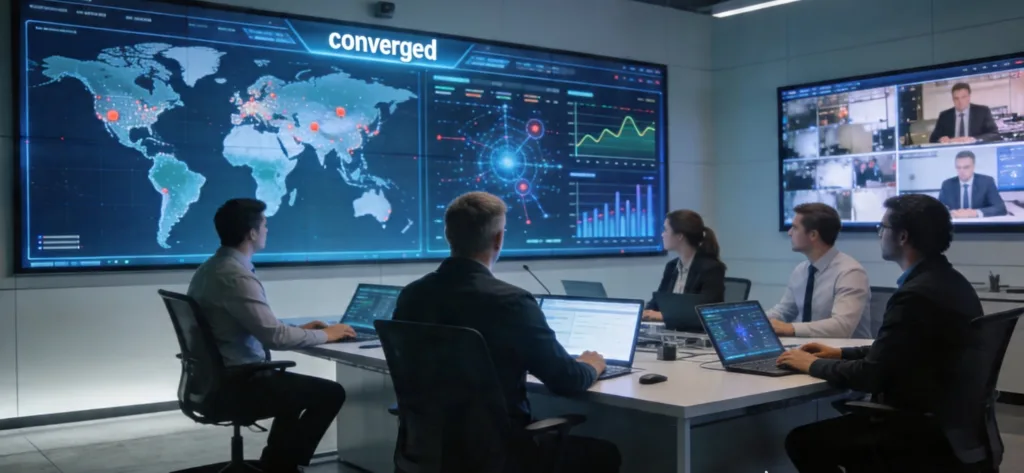
Converged security crisis management treats the entire sequence as one event. The same command structure monitors the digital exposure, coordinates the residential security posture, briefs the protective detail, and advises the principal’s communications team. The response is faster, tighter, and less likely to produce the secondary incidents that fragmented response often creates.
The HKDS Approach to Security Crisis Management
HK Defense Solutions structures security crisis management around four integrated functions: detection, decision, execution, and after-action.
Detection means continuous monitoring across physical, digital, and reputational domains. Protective intelligence analysts monitor the principal’s public footprint, dark web mentions, and media references. Physical security operators monitor residential perimeters, staff behavior, and movement patterns. Cyber monitoring covers principal and family device hygiene, credential exposure, and communications integrity. All three feed into a single operational picture.
Decision means having predefined escalation thresholds and a clear chain of authority for activating response. When an indicator crosses a threshold, the team does not spend ninety minutes in a conference call deciding whether to respond. The protocol activates, roles are assigned, and execution begins.
Execution means running the actual response with operators who know the principal, the environment, and each other. In a real security crisis, unfamiliar teams lose time to introductions, capability questions, and authority disputes. HKDS keeps the same operators assigned to a principal across engagements specifically to eliminate that friction.
After-action means a documented review of what happened, what worked, what did not, and what changes are required to the standing security program. Without this step, security crisis management degrades into reactive firefighting. With it, every incident improves the posture.
Security Crisis Management for Family Offices
Family offices sit in a particularly vulnerable position when it comes to security crisis management. Most family offices are small, generalist teams responsible for financial, legal, operational, and lifestyle matters for a principal and family. Security is often handled by a single chief of staff or head of security who is not a trained protective operator.
When a real crisis begins, that individual becomes the single point of failure. They are expected to coordinate between guard services, cyber vendors, local law enforcement, legal counsel, and the principal’s family while simultaneously running the operational response. Most people cannot do that well under pressure. It is not a reflection on them. It is a reflection on the structure.
HK Defense Solutions works directly with family office leadership to build security crisis management plans that do not depend on a single overloaded individual. The plans define roles, escalation paths, and decision authority in advance. The operators running the response are the same operators who cover the principal day to day. The result is a family office that can continue functioning during a crisis rather than collapsing into it.
Security Crisis Management for Corporate Principals
Corporate principals face a different security crisis management challenge. The CEO, founder, or senior executive is a dual-role target. They carry personal exposure as a wealthy individual and organizational exposure as a representative of the company. A crisis affecting them can trigger shareholder, regulatory, and public relations consequences well beyond the immediate safety event.
HK Defense Solutions structures corporate executive security crisis management around the intersection of those two exposure surfaces. The personal protection program and the corporate risk management program are coordinated so that a crisis affecting the executive can be contained before it escalates into an organizational event. That coordination requires direct communication between the protection team and the corporate general counsel, communications lead, and board-level risk committee.
For boards and audit committees evaluating whether their organization’s executive security crisis management program meets oversight standards, HKDS publishes the Board-Level Risk and Continuity Oversight Checklist as a free download on hkdef.com. The checklist covers the specific questions boards should be asking about executive protection, crisis response, and continuity planning.
Training, Rehearsal, and Continuous Improvement
Security crisis management only works if the team has rehearsed the plan. HKDS conducts periodic tabletop exercises with family office and corporate clients to pressure-test the response plan against realistic scenarios. These exercises identify gaps before they matter, and they give the client’s team the experience of running the plan in a low-stakes environment.
Without rehearsal, every real incident is the first time the team has executed the plan. That is when things go wrong.
Engaging HKDS for Security Crisis Management
Family offices, chiefs of staff, and corporate security directors who want to evaluate their current security crisis management posture can request a Private Threat Mapping Session with John Hamilton. The session includes a review of existing crisis response protocols, a gap assessment against the HKDS converged standard, and a documented recommendation for closing identified exposures.
To schedule a session, apply at hkdef.com. To begin a self-guided assessment, download the Board-Level Risk and Continuity Oversight Checklist and the Converged Digital Exposure Checklist from the downloads section of our site.
The worst time to build a security crisis management plan is during a security crisis. The best time was six months ago. The second best time is today.
Crisis Categories UHNW Families Actually Face
Security crisis management is not a single discipline. It is a set of response capabilities that have to fire correctly across very different scenarios. UHNW families in Florida and New York face a recurring set of crisis categories: medical emergencies during travel, kidnap or extortion threats, stalker escalation, protest or media siege at a residence, cyber intrusion combined with physical threat, contested custody or family litigation spilling into physical safety, and natural disasters affecting estate continuity.
Each of these requires different immediate actions, different communication protocols, and different handoff sequences. Real security crisis management builds playbooks for each category and rehearses them with the family office, the principal protection team, the residential staff, and outside counsel before anything happens.
Regional Crisis Response Considerations
In Palm Beach and Jupiter Island, hurricane continuity is a recurring crisis management category. Security crisis management plans for Florida estates need to account for mandatory evacuation orders, residence hardening before storm arrival, staff safety, and re-entry coordination after the storm passes.
In Miami, the crisis mix shifts toward personal threat, international exposure, and media pressure. Security crisis management in Miami routinely involves coordination with private aviation for rapid departure, hotel extraction, and discreet relocation to secondary residences.
In Manhattan and Greenwich, security crisis management has to work inside a dense urban environment where protest, activist targeting, and media siege are more common than in Florida. Evacuation routes from Upper East Side residences or Greenwich estates require pre-planning that most security providers never document.
Frequently Asked Questions About Security Crisis Management
What is the difference between crisis response and crisis management?
Response is what you do in the first sixty minutes. Management is the sustained coordination across days or weeks that contains damage and restores normal operations. Both matter. Firms that only do response leave families exposed during the recovery phase.
Who should be on a crisis management plan?
The principal, the family office chief of staff, legal counsel, PR counsel, protective intelligence lead, executive protection detail leader, residential security lead, and medical support. Clear roles, clear authorities, clear communication channels.
How often should security crisis management plans be updated?
At least annually, and immediately after any significant change in the principal’s exposure profile, residence, travel pattern, or family composition.
Can HK Defense Solutions integrate with our existing crisis plan?
Yes. HKDS frequently audits, rewrites, or supplements existing family office crisis plans. The converged security model is designed to overlay physical, protective intelligence, cyber, and reputation response under unified command.
Moving From Reaction to Readiness
Security crisis management built correctly means the crisis happens and most people in the principal’s orbit never notice. Book a private threat mapping session with John Hamilton at hkdef.com to stress-test your current plan. Download the Board-Level Risk and Continuity Oversight Checklist and the Converged Digital Exposure Checklist for a structured benchmark.