
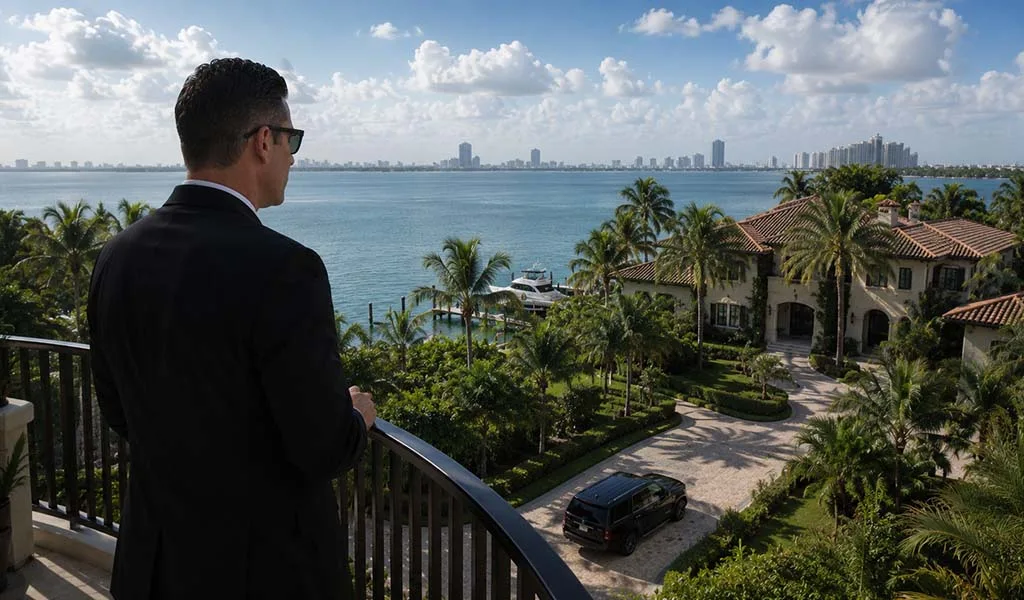
I’ve worked estates on all three. They are not the same environment and they don’t need the same architecture. If you’re evaluating security for a Miami island residence, this is what I’d want you to understand before anyone pitches you a proposal.
Indian Creek — the strongest baseline in the country
Indian Creek Village is a functioning municipality with its own police force. 13 officers. 24/7 patrol by land and water. Single-bridge access with a checkpoint. Radar and thermal marine surveillance. 41 lots. 300 acres. Approximately 84 residents when everyone’s home.
By any measure, this is the strongest structural baseline of any UHNW residential environment in the United States.
It’s also not enough for the current concentration.
Mark Zuckerberg’s $170M March 2026 purchase set the Miami-Dade record. Jeff Bezos is over $230 million across three properties. Tom Brady. Ivanka Trump. The concentration produces target dynamics the village architecture was never designed for.
What the village does well: it stops opportunistic threats. It stops random reconnaissance. It handles the perimeter with real capability.
What it doesn’t do: it doesn’t fill the gap between the perimeter and your specific principal exposure. It doesn’t vet your household staff. It doesn’t monitor the drone that’s been flying grids over your lot on Tuesday mornings for three weeks. It doesn’t address the voice cloning attack that’s coming for your family office next quarter.
The specific vulnerability I look at first on Indian Creek is the vendor access category. Construction crews. Municipal service workers. The ongoing wastewater management dispute creates recurring windows where non-resident personnel have legitimate reasons to be on the island. Every one of those windows is an operational access point that private estate security has to manage.
Our own detailed coverage on estate security at Fisher Island, Star Island, and Indian Creek breaks down the tier-by-tier architecture each environment requires.
Star Island — HOA architecture, not municipal
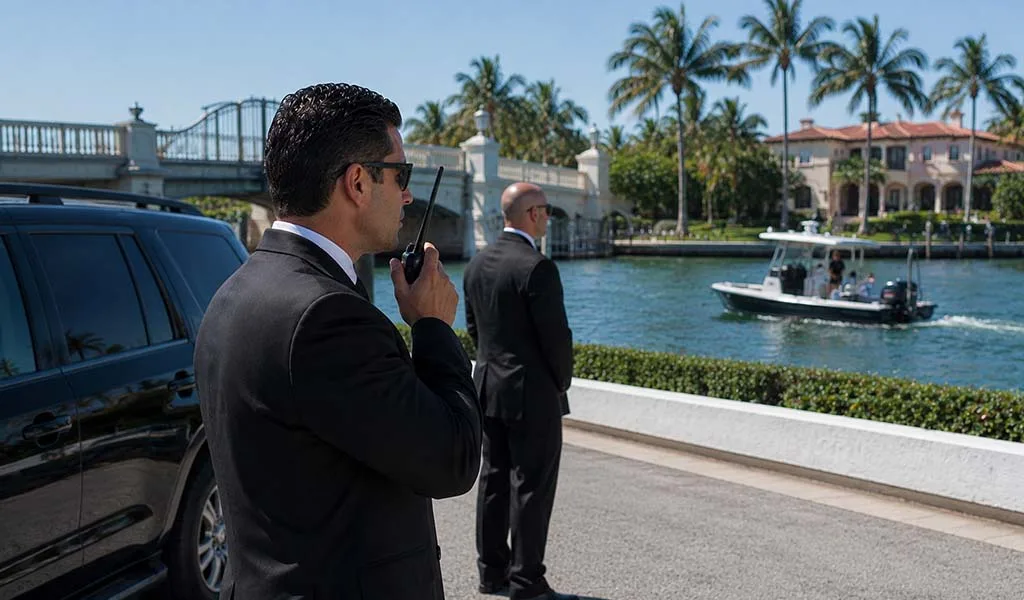
Star Island is a different animal. 35 homes on a man-made island off the MacArthur Causeway. Guard-gated entrance. HOA-level security infrastructure. A Star Island estate publicly traded for $120 million in early 2025, which was Miami-Dade’s record until Zuckerberg reset it two months later.
The HOA architecture handles perimeter access. It doesn’t do what the Indian Creek village police force does. It doesn’t do 24/7 marine patrol. It doesn’t produce the deterrence effect that a municipal police presence produces.
For Star Island principals, the specific gap is larger than at Indian Creek because the baseline is less capable. The individual estate has to do more to compensate. Marine-side surveillance is more critical. Household staff vetting is more critical. Access control at the individual gate is more critical.
The Star Island buyer profile also tends toward more public visibility than Indian Creek. Musicians, athletes, entertainment figures with public documented presence. That visibility produces a different reconnaissance environment.
Fisher Island — ferry-only, amenity-driven, densest
Fisher Island runs on a fundamentally different operational model. Ferry-only access. Amenity-driven residential character. Denser than either Indian Creek or Star Island. More like a private community with hotel-adjacent operations than an isolated island estate environment.
The security architecture for Fisher Island is closer to a Manhattan luxury building than to an isolated estate. Building-level and community-level security handle a lot of the baseline. Individual residence security fills the gap between community coverage and specific principal exposure.
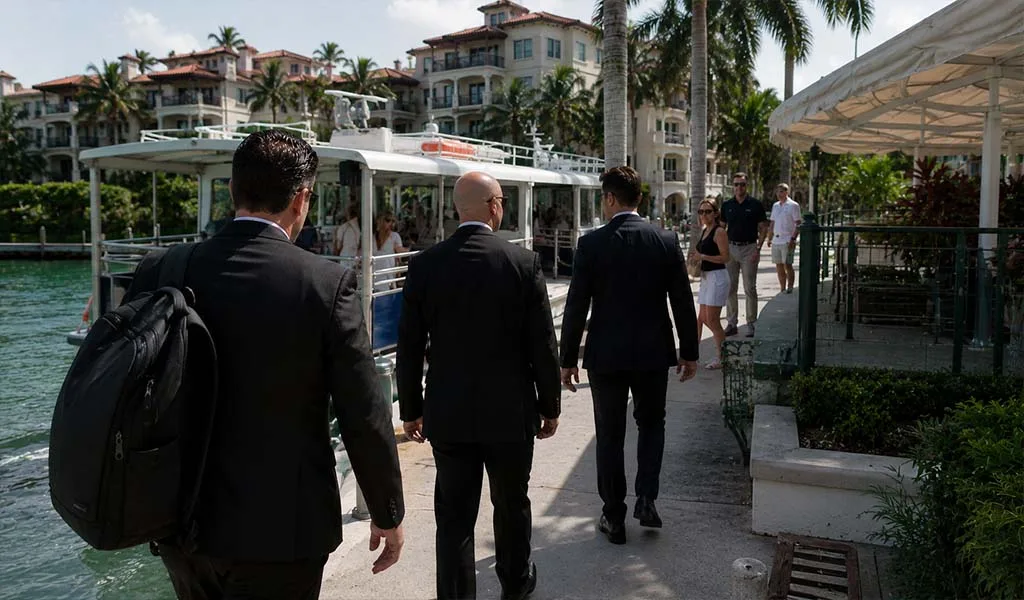
The ferry access creates a specific pattern most buyers don’t think about. Everyone on the island either lives there, works there, or is a guest of someone who does. That access control provides real filtering. But the flip side is that vendor and service traffic is constant, ferry schedules are documented, and the operational rhythm is highly predictable — which is exactly the intelligence a sophisticated reconnaissance operation is designed to gather.
The mistake I see buyers make
The mistake I see most often is buyers concluding they need the same security architecture on Indian Creek that they’d need on Star Island or Fisher Island — or vice versa. The environments are structurally different. The threat profiles are different. The architecture that closes the gap between community baseline and principal-level exposure is different for each.
If a provider pitches you the same proposal for any of these three environments without asking specific questions about which environment you’re actually in, that’s your answer. They’re not architected for the territory. They’re selling a template.
Katherine Clarke’s ongoing WSJ Mansion coverage has documented the transaction pace at all three islands specifically because the pattern matters. If you want to understand what the current market actually looks like, that’s the source I’d read.
Where I'd start
If you’re a current or prospective principal on any of these three islands, start with a formal audit specific to your environment. Not a residential audit template applied broadly. The specific gap analysis for your specific island and your specific estate profile.
Where to Go From Here
Start with the Estate Operations & Insider Risk Checklist. It’s the same 15-point audit we run on every new principal, and it works across all three islands because the fundamentals apply everywhere.
If you’re ready to talk directly, request an audit here. Confidential. If we’re not the right fit for your specific environment, I’ll tell you.
For the operational context on the broader Miami and Fort Lauderdale corridor, read our coverage on 24/7 mobile patrol security in Miami.
I’m John Hamilton, HKDS founder. We provide estate security, executive protection, and converged physical-digital security across Miami and the surrounding private island tier. Licensed Florida Class B, D, and G. Contact us.