
The first time we walk a new client through their Manalapan estate, we ask the same opening question: “Show us what watches the water.”
What follows is usually a moment of silence. Then a slightly defensive answer along the lines of: “There’s a camera on the dock,” or “The seawall has motion sensors,” or “We’ve never had any issues from that side.”
That last answer is the most revealing. Not because it’s wrong — most Manalapan estates haven’t had documented incidents from the water side. It’s revealing because it confirms the security model was designed around historical patterns rather than current exposure.
What’s actually happening on the Intracoastal
The Intracoastal Waterway runs north to south along the western edge of Manalapan, separating the barrier-island portion from the mainland peninsula. During daylight hours, the waterway carries continuous traffic: pleasure craft, fishing boats, water taxis, charter cruises, and the real-estate-tour boats that have become a documented feature of Manalapan’s media coverage.
Most of this traffic is benign. People are enjoying their boats, going fishing, or showing properties to legitimate prospective buyers. That’s not the security concern.
The security concern is that the same waterway also carries surveillance opportunities that are functionally indistinguishable from the legitimate traffic. A boat that lingers near a specific property for 20 minutes looks identical to a fishing vessel. A drone launched from a public boat ramp in Lantana can document a Manalapan estate’s interior from above without ever flying over private land. A vessel anchored 100 yards offshore at night, lights off, looks like nothing in particular to anyone not specifically looking for it.
The Intracoastal traffic provides perfect concealment for surveillance against a Manalapan estate. The tools that would detect it are uncommon. The protocols that would respond to it are rare.
What marine-side surveillance actually involves
A complete marine-side surveillance posture for a Manalapan estate includes several components most properties currently lack.
AIS monitoring. The Automatic Identification System (AIS) is a transponder protocol used by commercial vessels and increasingly by recreational boats. AIS data is publicly available. A surveillance posture that monitors AIS activity in the Intracoastal corridor adjacent to a property can identify vessels that linger, that return repeatedly, or that operate in patterns inconsistent with normal traffic. Almost no Manalapan estate security program currently incorporates AIS monitoring.
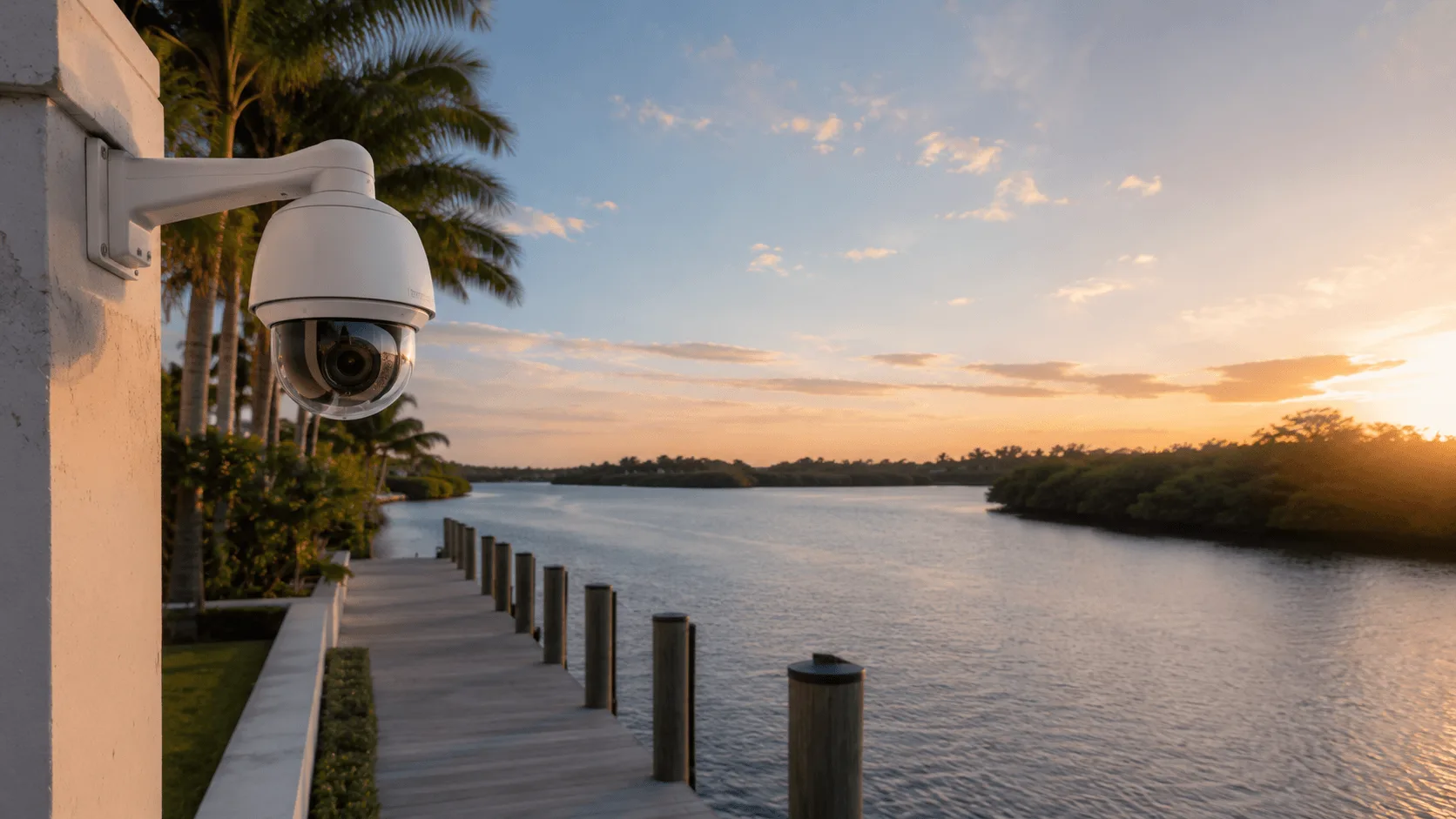
Camera coverage oriented for water approach. Most camera systems on Manalapan estates orient toward the road, the gate, the driveway, and the front of the residence. The water-facing camera coverage is typically one or two units pointed at the dock. A complete water-side camera posture covers the seawall, the dock approach, the boathouse interior if applicable, the immediate offshore area, and the visible stretch of the Intracoastal in both directions.
Seawall and dock sensors. Pressure sensors, motion detectors, and thermal imaging at the seawall and dock level. The objective is detection of unauthorized approach by swimmer, dinghy, or small craft — the access methods that would not appear on AIS and would not be visible to camera systems oriented toward larger threats.
Drone detection. The Intracoastal-side approach for drones is particularly vulnerable because public boat ramps and parks across the water provide perfect launch points outside the estate’s airspace. A drone can document an estate’s pool, layout, and interior windows without ever crossing the property line in the air. Detection systems oriented for water-launched aerial surveillance are essential.
Watercraft approach protocols. When an unauthorized vessel approaches the dock or seawall, what happens? Most estates have no answer. Our protocols include: detection, identification (AIS check, visual identification), warning, response (depending on threat assessment), and documentation for legal follow-up. The response should not be improvised at the moment of incident.
Integration with broader estate security. The marine-side posture is not a standalone system. It’s an extension of the integrated estate security program. When an unauthorized vessel is detected, the estate’s response posture adjusts. When the principal is in residence, response protocols differ from when the property is in vacancy mode. When suspicious activity occurs from the water side, road-facing security awareness increases automatically.
The case study Manalapan owners should consider
We assessed a Manalapan estate where the principal had returned from a six-week summer absence to find that a removable wooden gate at the dock — installed for convenience to allow easier boat access — had been propped open at some point during the vacancy. The estate’s pool service had been on the property weekly. The landscape crew had been on the property bi-weekly. Neither group had reason to be at the dock.
The owner reported the open gate to local police and to us. Our forensic review of the property’s water-side cameras (one unit, oriented toward the dock from the boathouse) revealed nothing — the camera’s field of view didn’t include the gate itself.
Nobody knows when the gate was opened, by whom, or whether the property was accessed beyond the dock. There’s no evidence of theft. The principal moved on with their season.
But the incident reveals the gap. A water-side perimeter that depends on a single camera covering a single angle, with no AIS monitoring, no sensor coverage of the seawall, and no protocols for routine water-side awareness during vacancy, is functionally a wide-open perimeter. The fact that nothing was stolen isn’t evidence that the security worked. It’s evidence that nothing has happened yet.
What we recommend
For Manalapan estates, we treat the water-side perimeter with the same seriousness as the road-facing perimeter. The configurations differ for ocean-to-lake estates, peninsula-side properties, and Hypoluxo Island residences — but the principle holds: every estate has equal exposure on both sides, and the security posture should reflect that.
Our marine-side surveillance protocols are part of every Manalapan estate engagement. We document the current state, identify the gaps, and build the integrated posture that closes them.
Frequently Asked Questions
What is the Intracoastal Waterway and why does it matter for Manalapan estates?
The Intracoastal Waterway is the navigable channel running north-south along Florida’s east coast, including the western edge of Manalapan. It carries continuous boat traffic during daylight hours. Every Manalapan estate has Intracoastal-side exposure that is publicly observable from passing vessels.
What is AIS and why does it matter for estate security?
AIS (Automatic Identification System) is a transponder protocol used by commercial and increasingly recreational vessels. AIS data is public. Monitoring AIS activity in the Intracoastal corridor adjacent to an estate can identify vessels that linger or return repeatedly — patterns inconsistent with normal traffic.
Do most Manalapan estates have marine-side surveillance?
No. Most Manalapan estates have one or two cameras oriented toward the dock and minimal sensor coverage on the seawall. Few have AIS monitoring, drone detection, or formal watercraft approach protocols.