
In 2020, Manalapan was a 2.4-square-mile barrier-island town that the Wall Street Journal once described as Palm Beach Island’s quieter, less-glitzy southern neighbor. Approximately 425 residents. Median home values around $4 million. Best known for the Eau Palm Beach Resort, the Lofthus shipwreck off its shore, and being the “safest town in Florida” by FBI crime statistics.
Five years later, that description is obsolete.
In 2022, Larry Ellison closed on a 16-acre Manalapan estate at $173 million — a Florida price record. The transaction made international news within hours. Aerial photography of the estate appeared in Forbes, Bloomberg, and the Wall Street Journal. The estate’s location — easily identified from any tour boat on the Intracoastal Waterway — became a fixed feature of every Palm Beach real estate article published since.
In 2025, local developer Stewart Satter began building a spec home on Manalapan’s barrier-island side, currently listed at $285 million. During the 2024 election cycle, he flew a giant Trump flag above the construction site, generating its own news cycle and turning the property into a recognizable landmark before construction was complete.
In the past two weeks of 2025, a single real estate broker reported closing more than $150 million in Manalapan-area deals. Median listings in Manalapan now range from $20 million to $40 million. Average home values are above $4 million but the trophy properties — the ocean-to-lake estates spanning both sides of A1A — routinely command $30 million to $100 million-plus.
This is no longer a quiet barrier-island town. It is one of the most concentrated, most internationally-visible trophy real estate markets in the United States.
The security infrastructure has not caught up.
The exposure pattern
Manalapan’s transformation created a specific threat profile that most residents, real estate agents, and even local security firms have not fully internalized.
When a $4 million home sells in a residential neighborhood, the transaction generates a property record and disappears into the data stream. Nobody outside the immediate area pays attention. The property is one of millions in similar price ranges across America.
When a $173 million estate closes in Manalapan, the transaction is documented in international media within hours. Aerial photography is published. The buyer is named. The property’s location is described in detail sufficient for anyone to identify it from the water. And the property remains a fixture in real estate journalism for years afterward, referenced every time another Manalapan transaction approaches a similar threshold.
Every principal who owns a Manalapan estate above the $20 million threshold is now an internationally-documented address. Their property is identifiable from satellite imagery, from tour boats on the Intracoastal, from Google Earth flyovers, and from the dozens of real estate, wealth, and luxury publications that have featured Manalapan over the past three years.
This visibility is the new threat baseline. It was not the baseline five years ago. The security models that worked five years ago were not designed for it.
The Intracoastal tour boat problem
Real estate journalist Edward Elkins routinely takes wealthy buyers on Intracoastal boat tours of Manalapan estates aboard a Hinckley named “The Deal-Closer.” The Wall Street Journal documented one such tour in 2025: “Elkins cruised down the Intracoastal in The Deal-Closer, passing mansion after mansion, most with their own docks.” The tour included a deliberate route through the Boynton Inlet into the Atlantic specifically to view Larry Ellison’s 16-acre property from the water.
This is not a one-time occurrence. Tour boat operations, real estate showings via vessel, charter cruises, and pleasure craft routinely traverse the Manalapan stretch of the Intracoastal Waterway. Every estate’s water-side perimeter is publicly observable. Daily.
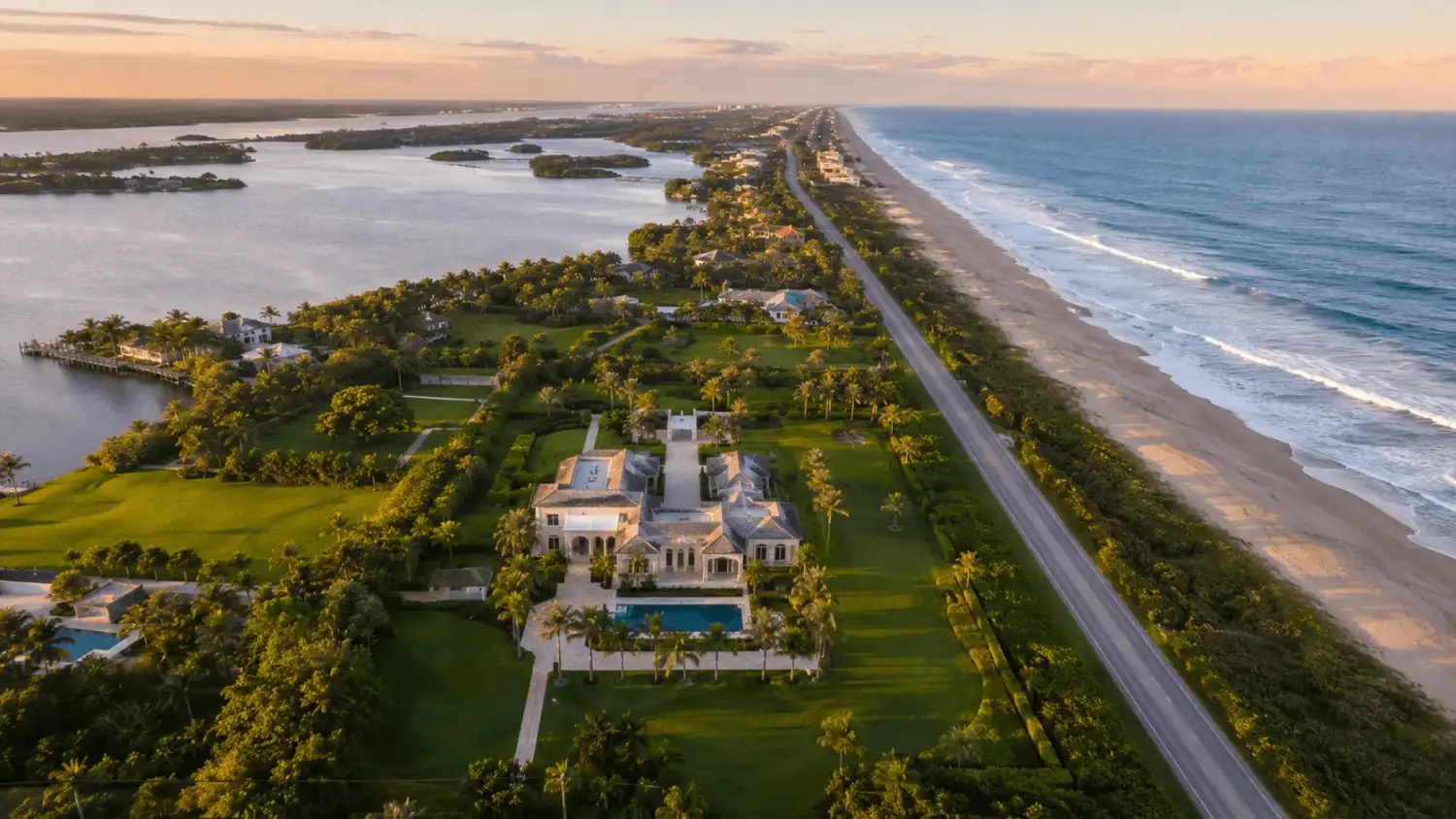
For most homes in most American neighborhoods, the front of the property faces a public street and the back of the property is concealed. In Manalapan, both sides are exposed — the road-facing side to anyone driving A1A, the water-facing side to anyone with a vessel. The “private” side of an estate functionally does not exist.
The ocean-to-lake estate problem
The most prestigious Manalapan property type — the configuration that commands the highest prices and the most international attention — is the ocean-to-lake estate. These properties span both sides of A1A, with a main residence on one side and a beachhouse, pool house, or guest house on the other. A tunnel typically runs underneath A1A connecting the two structures.
The configuration is the symbol of arrival in Manalapan. It is also a security model unlike any other residential property type in America.
A traditional luxury estate has one perimeter, one front, one back. An ocean-to-lake Manalapan estate has four distinct exposure surfaces:
- The Atlantic Ocean side (waterfront, sand access, boat approach)
- The A1A road frontage (public road, vehicle traffic, pedestrian visibility)
- The Intracoastal Waterway side (vessel traffic, dock approach, AIS-trackable boats)
- The connecting tunnel (subterranean access between two structures, with vehicle traffic above)
Each surface requires its own surveillance, its own access protocols, its own response model. The four surfaces must operate as one integrated security posture rather than four separate problems. Almost no estate security program in Manalapan currently does this.
The seasonal vacancy compounding factor
Manalapan’s full-time residential population is approximately 400 people. The seasonal population swells during winter and collapses from May through October when residents return to primary homes in New York, Greenwich, the Hamptons, or international markets.
For 5-6 months a year, estates worth $20 million to $100 million sit vacant. The maintenance staff, pool service, and landscape crews continue working. The household has a skeleton presence at most. The principal is 1,200 miles away.
Every threat factor described above — international visibility, water-side exposure, multi-axis perimeter, public records propagation, deed theft surge — compounds during the off-season. The property is identifiable, observable, reachable, and known to be empty.
What this means
Manalapan principals are not in danger. The town’s crime statistics remain among the lowest in Florida. The community’s reputation for safety is real and earned.
But the threat profile — the surface area available to a sophisticated targeting operation — has changed dramatically. The estate that was secure in 2018 with an alarm system, a maintenance schedule, and a pool service contract is not secure in 2026 against the same techniques applied to the same property. The world found Manalapan. The security model has to find it back.
We assess every Manalapan principal we work with against the current threat profile, not the historical one. The Estate Operations & Insider Risk Checklist below covers the foundation. The full security architecture is what we build next.
Frequently Asked Questions
What is Manalapan, FL?
Manalapan is a 2.4-square-mile barrier-island town in Palm Beach County, Florida, with approximately 425 residents. Average home values are around $4 million but median listings now range from $20 million to $40 million, with trophy ocean-to-lake estates regularly trading at $50 million to $173 million.
Why is Manalapan considered exposed despite being a private community?
Manalapan estates are observable from the Intracoastal Waterway by tour boats, charter vessels, and real estate showings via boat. International media coverage of major transactions has made specific properties globally recognizable. Florida’s public property records make every transaction findable, and the town’s small population concentrates trophy real estate in a geographically tiny area.
What is an ocean-to-lake estate?
An ocean-to-lake estate spans both sides of A1A — with a main residence on one side and a beachhouse or pool house on the other, typically connected by a tunnel under the highway. This configuration is the most prestigious property type in Manalapan and creates a multi-axis security challenge unlike any other residential property type.