
I’ve worked estates on all three of Miami’s private islands. Indian Creek, Star Island, Fisher Island. Each has its own baseline architecture and its own gap between that baseline and current-concentration principal-level exposure.
What I want to walk through here is how sophisticated engagement actually operates against these environments — because most residents I talk to have a mental model that describes opportunistic threats rather than the coordinated operations that current threat actors are running.
Our own coverage on estate security at Fisher Island, Star Island, and Indian Creek covers the tier-by-tier architecture each environment requires.
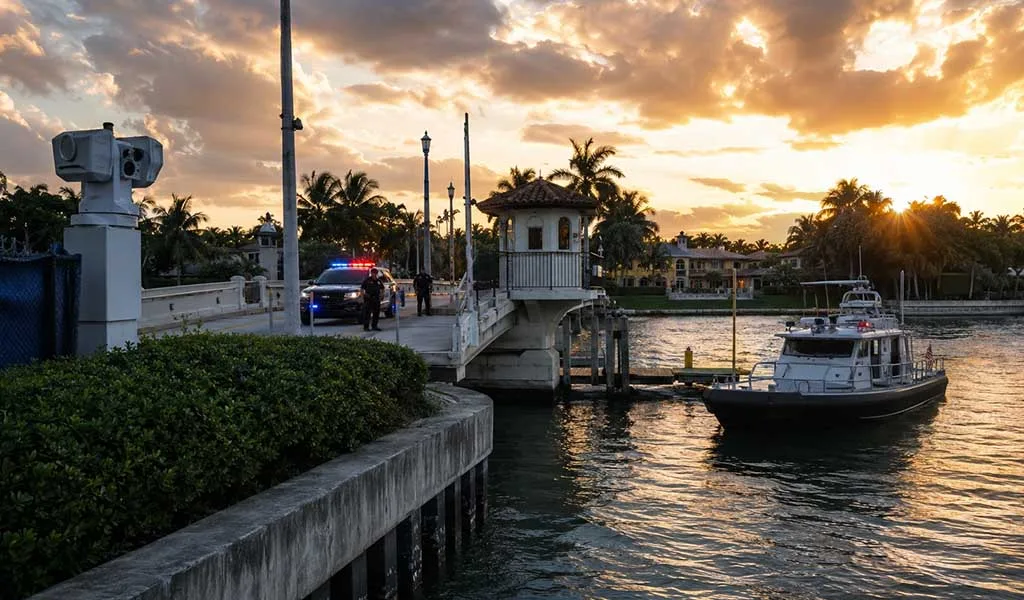
The village baseline at Indian Creek
Indian Creek Village operates the strongest structural residential baseline in the country. Thirteen-person municipal police force. Single-bridge access with checkpoint screening. Marine surveillance with radar and thermal imaging. Continuous perimeter patrol by land and water.
For opportunistic threats, this baseline is effectively complete. Random reconnaissance gets filtered before it reaches individual estates. Casual approach patterns get identified. Opportunistic actors get excluded structurally.
The mistake most residents make is assuming that “the strongest baseline in the country” translates to “sufficient architecture for principals at Zuckerberg-Bezos concentration.” That’s not what the village baseline was designed for.
The village handles perimeter and opportunistic threats. It doesn’t handle coordinated multi-vector engagement against specific principals by resourced adversaries.
How coordinated engagement actually works
Let me walk through what I’ve seen operationally, because the pattern matters.
Phase one is target identification. Not target selection — that’s phase two. Identification is the initial intelligence work that determines which principals are worth engaging against. This work happens entirely in public. Real estate coverage. SEC filings. Property records. Social media. News coverage. Corporate filings. Family office media coverage. All of it aggregable through publicly available sources.
Katherine Clarke’s WSJ Mansion coverage has documented the transaction pace at Indian Creek specifically because the market pattern makes principal identification straightforward. That’s not Clarke’s fault — that’s the nature of how the current UHNW real estate market operates. But it does mean that phase one identification against Indian Creek principals is materially easier than it would be against principals in less-covered markets.
Phase two is target selection. Multiple identified principals get evaluated against operational criteria. Documented value at the property. Assessed operational vulnerability. Owner profile and estimated resistance capability. Access dynamics. Recovery scenarios including insurance coverage and law enforcement response.
Estates that display sophisticated pattern-of-life management, counter-surveillance awareness, and integrated architecture tend to be deselected in favor of properties that display more predictable patterns. The specific vulnerability that target selection identifies is often not physical infrastructure. It’s operational discipline.
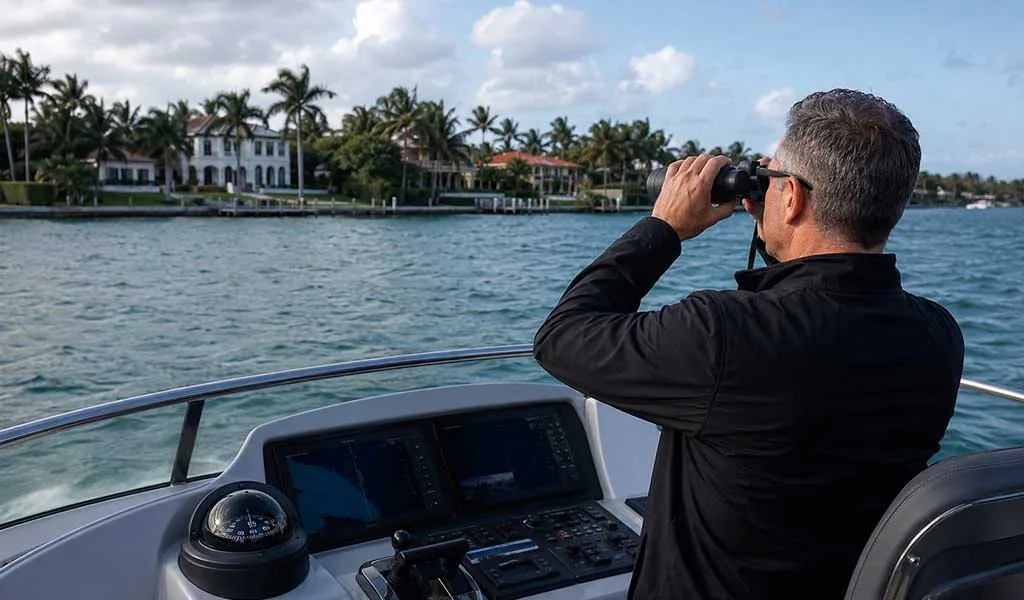
Phase three is detailed reconnaissance. Multi-week or multi-month observation of the selected target. Vehicle-based observation from public roads. Marine-side observation from the Intracoastal. Digital reconnaissance through social media, staff LinkedIn profiles, vendor relationships visible through corporate records.
Phase four is operational planning. Timing based on documented occupancy patterns. Access vectors based on reconnaissance findings. Extraction plans developed simultaneously with entry. Contingency plans for unexpected household presence, security response, and law enforcement engagement.
Phase five is engagement. The shortest operational phase. Well-planned operations execute in 15 to 60 minutes. The characteristic that distinguishes planned engagement from opportunistic crime is operational discipline during execution. Movements are efficient. Time on target is minimized. Communication is structured. Extraction is planned as carefully as entry.
Where village architecture stops working
The village architecture handles phases four and five reasonably well when it comes to obvious approach patterns. Suspicious vehicles get identified at the bridge. Unusual marine approach gets caught by patrol. Direct physical intrusion attempts get intercepted.
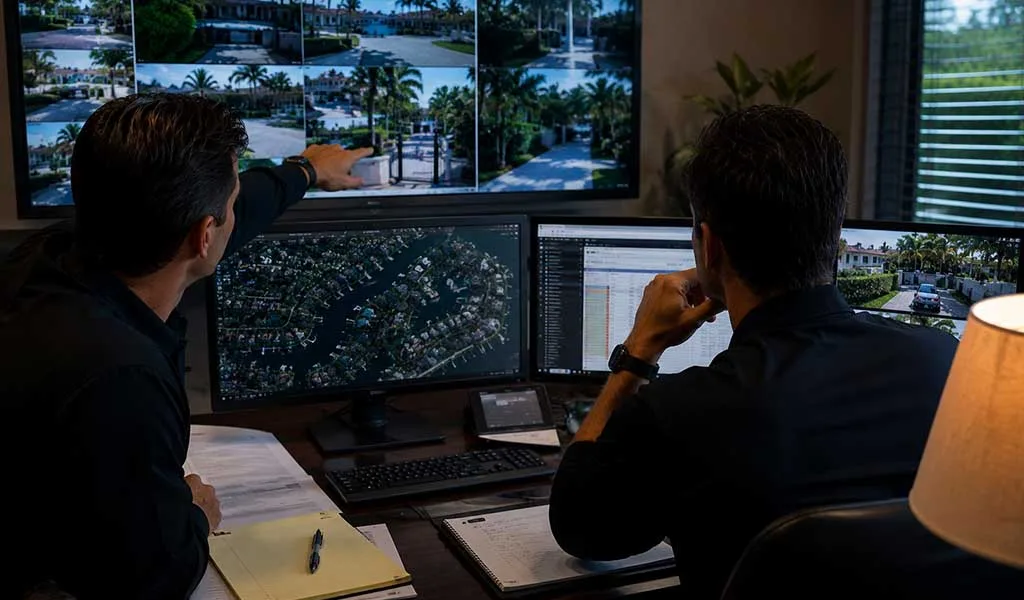
What the village architecture doesn’t do is address phases one, two, and three. Target identification happens entirely in public. Target selection happens through observation of externally visible operational patterns. Detailed reconnaissance operates from off-island positions that village police don’t monitor.
Individual estate security architecture is what closes those gaps. Counter-surveillance operations against phase-three reconnaissance. Pattern-of-life management that makes phase-two selection less favorable. Operational discipline that makes the estate a harder target than adjacent alternatives.
The wastewater vendor access category
I mentioned this in an earlier piece and it’s worth expanding. The ongoing wastewater management dispute at Indian Creek creates windows during which non-resident personnel have legitimate reasons to be on the island. Construction crews. Utility contractors. Environmental consultants. Municipal service workers.
Each of those categories represents legitimate access that would filter through village screening. Each represents a potential social engineering vector that sophisticated engagement operations exploit at other environments.
For principals whose Indian Creek residence involves active construction, remodeling, or infrastructure work, the vendor access pattern during that period is a specific vulnerability category requiring architecture beyond the standard village baseline.
The Star Island and Fisher Island distinctions
Star Island’s HOA-level architecture is meaningfully less capable than Indian Creek’s municipal police baseline. The gap between community security and principal-level exposure is larger. Individual estate architecture has to do more.
Fisher Island’s ferry-only, amenity-driven model operates on different dynamics entirely. Access filtering is real but produces different reconnaissance environment characteristics. The specific security architecture required is closer to a Manhattan luxury building than to an isolated island estate.
Providers who pitch identical architecture across the three environments aren’t architected for the tier-specific reality.
What I'd recommend
For any principal on Miami’s private island tier, three practical priorities.
Understand what your community baseline actually addresses and what it doesn’t. Don’t over-rely on the perimeter architecture. It’s not designed for sophisticated engagement against your specific principal exposure.
Address the identification and reconnaissance environment specifically. This is the phase where your operational discipline determines whether you get selected or deselected in target selection.
Integrate your cyber and physical security under one command structure. Fragmented architecture is what the current threat sophistication is designed to exploit.
Daphne Nikolopoulos’s coverage in Palm Beach Illustrated and comparable publications documents the resident profile and community dynamics across the corridor. The NBC 6 South Florida coverage provides ongoing local context.
Where to Go From Here
Start with the Estate Operations & Insider Risk Checklist — the 15-point audit we run on every new principal.
If you’re ready for a direct conversation, request an audit here. We assess for the specific engagement profile the current environment produces.
For the specific EP architecture across Miami, read our executive protection coverage for Miami.
I’m John Hamilton, HKDS founder. We provide estate security, executive protection, and converged physical-digital security across Miami. Contact us.