
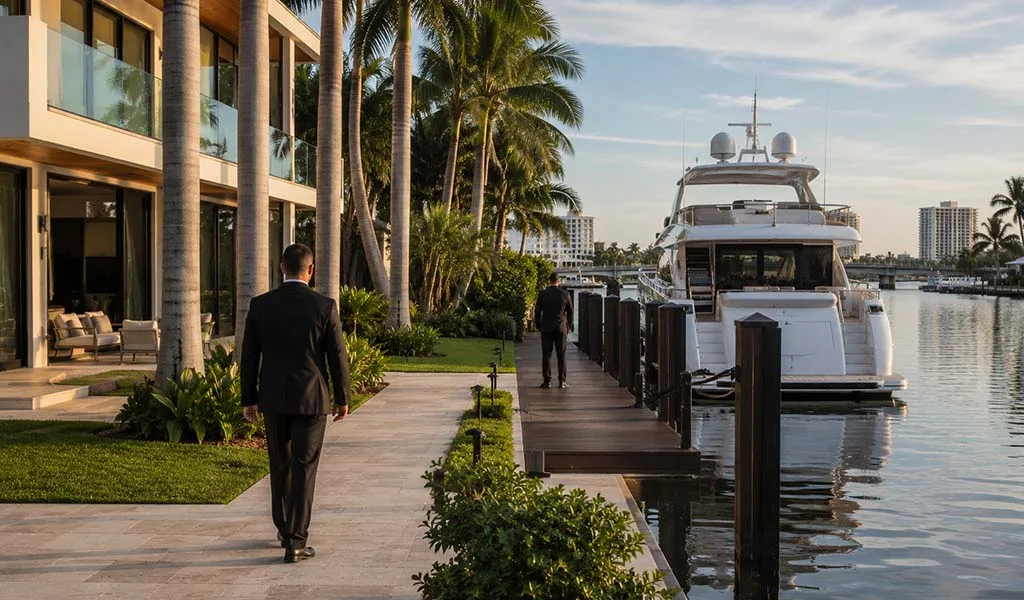
Fort Lauderdale operates on a geography that no other major American luxury market matches. The nickname “Venice of America” is not marketing. The city genuinely operates on a network of navigable canals that give thousands of estates direct water access, with the deepwater port of Port Everglades anchoring the marine industry and Bahia Mar and Pier Sixty-Six serving as the yacht haven for the region’s private vessel owners.
The upcoming Fort Lauderdale International Boat Show, scheduled for October 28 through November 1, will bring 90,000+ visitors to the city and hundreds of vessels valued cumulatively in the billions. Between now and then, hurricane season peaks. For yacht owners and canal-front estate residents, mid-summer through the boat show is the security window that matters most.
Our own coverage on maritime superyacht security in Fort Lauderdale covers the specific integrated architecture the current environment requires.
The dual exposure that most owners underestimate
The specific security profile of Fort Lauderdale’s UHNW residential and yacht owner community involves an exposure category that most standard security programs are not architected for. It is not the residence and it is not the vessel independently. It is the operational interaction between the two.
A typical Fort Lauderdale UHNW owner has a canal-front residence with a private dock. The dock hosts a vessel that ranges from 60 feet to 200+ feet depending on the owner’s profile. The residence and the vessel share household staff, share captain and crew coordination, share vendor relationships, and share operational patterns that reflect the owner’s travel and use calendar.
That combined operational picture creates a specific vulnerability profile. Reconnaissance can happen from three directions: land-side against the residence, water-side against the vessel, and dockside against the transition between them. Our detailed coverage on superyacht security solutions addresses the specific vessel-side architecture the current threat environment requires.
The AIS visibility problem
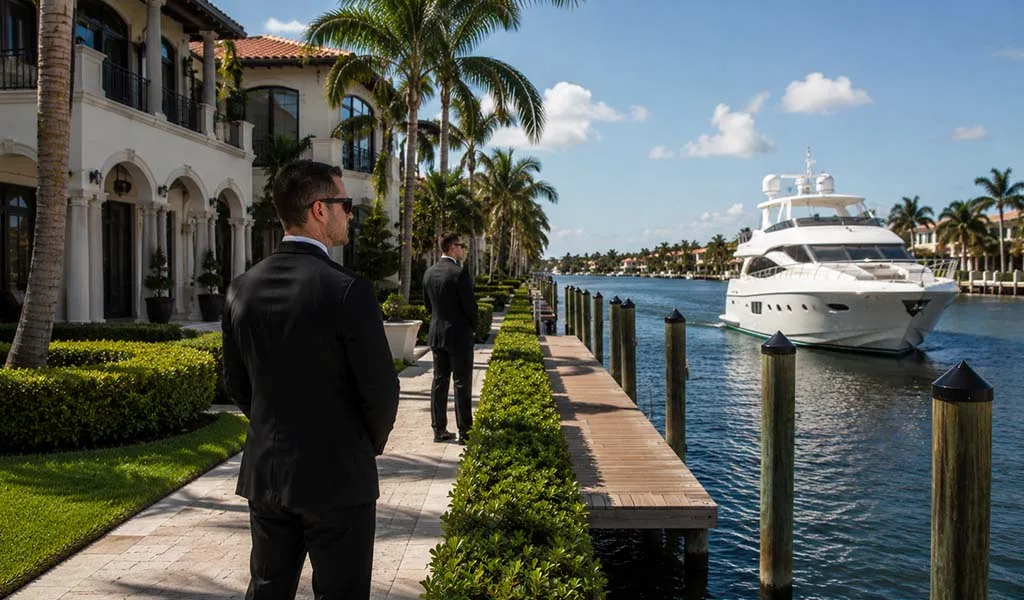
Every commercial vessel and most yachts above certain size thresholds broadcast Automatic Identification System (AIS) signals that are publicly trackable. For a $50 million yacht owner, the vessel’s movements are effectively public information. Departure from Bahia Mar. Transit through Port Everglades. Position in the Bahamas or Caribbean. Return timing. All of it visible to anyone with a browser.
For security, this visibility matters because it eliminates one of the traditional protections of vessel ownership. What that means operationally is that the residence occupancy pattern is public information. When the yacht departs, the owner is presumably not at the residence. When the yacht returns, the owner is presumably back.
That correlation is exactly the reconnaissance signal that organized crews look for. The Sun Sentinel’s ongoing coverage of yacht industry patterns provides local context for how the marine ecosystem shapes the operational environment.
The captain and crew vetting reality
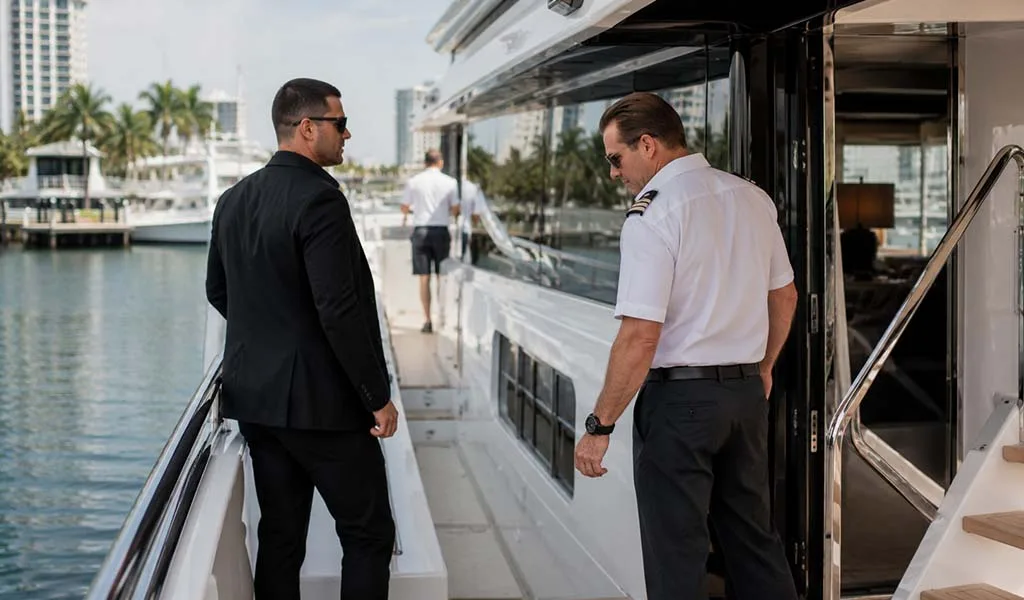
Captain and crew vetting standards vary substantially across the Fort Lauderdale marine industry. For owner-operated vessels below certain sizes, the vetting is often informal. For professionally captained vessels, standards are higher but not always sufficient for the trophy-yacht profile.
For owners with significant onboard value (art, watches, guest belongings, tenders, personal effects) and for owners whose crew turns over frequently between charter and private use, the vetting gap is a genuine security exposure. Our related coverage on how to secure a luxury yacht addresses the specific vetting architecture the current environment requires.
The boat show as target concentration
The Fort Lauderdale International Boat Show concentrates hundreds of high-value vessels and their owners in a defined location over five days. That concentration is a business opportunity for the industry and a security concentration for owners.
For principals attending the boat show or hosting yacht events during that window, the operational picture involves visible presence at a documented location with adjacent vessels of substantial value.
What to do now
For Fort Lauderdale yacht owners and canal-front estate residents, three practical priorities.
Integrate your vessel and residence security architecture. If your marine security is handled by your captain and crew while your residential security is handled by a separate provider with no coordination, the gap is where risk sits.
Address the AIS visibility reality directly. The historical assumption that vessel movements were private is no longer valid.
Vet your captain, crew, and marine vendor relationships against the current threat environment. If your last formal vetting review predates 2024, the standards have moved.
Ready to Take the Next Step?
Download the Estate Operations & Insider Risk Checklist.
The 15-point framework covering integrated vessel-and-residence vetting.
Read next:
Executive Protection in Fort Lauderdale
— the specific EP architecture for principals with integrated marine and residence exposure.
HK Defense Solutions provides estate security, executive protection, marine security integration, and captain and crew vetting for Fort Lauderdale yacht owners and canal-front residents. Contact our team.