
Jupiter’s estate landscape presents a different set of security challenges than the tight, land-constrained environment of Palm Beach Island. Properties here are larger. Lots are measured in acres, not square feet. Many include significant natural vegetation that provides privacy but also creates concealment opportunities. Waterfront exposure runs along the Loxahatchee River system, the Jupiter Inlet, the Intracoastal, and the Atlantic — sometimes multiple waterways simultaneously.
This combination of size, vegetation, and water access means that the perimeter defense for a Jupiter estate is more complex and more costly to implement properly than for a typical Palm Beach property. But the value of the properties and the profile of their owners demands it.
The specific challenges of Jupiter’s estate environment
for a quarter-acre lot on Palm Beach Island is inadequate for a 5-acre estate in Jupiter. The sensor network, the lighting plan, the camera placement, and the patrol routes all need to be designed for the actual property dimensions — not for a standardized residential security package.
Natural vegetation creates sight-line challenges. The mature trees, hedges, and landscaping that provide privacy also create blind spots that need to be addressed through camera placement, sensor coverage, or patrol patterns. In some cases, selective vegetation management is part of the security recommendation — opening sight lines in specific areas without compromising the privacy that the landscaping was designed to provide.
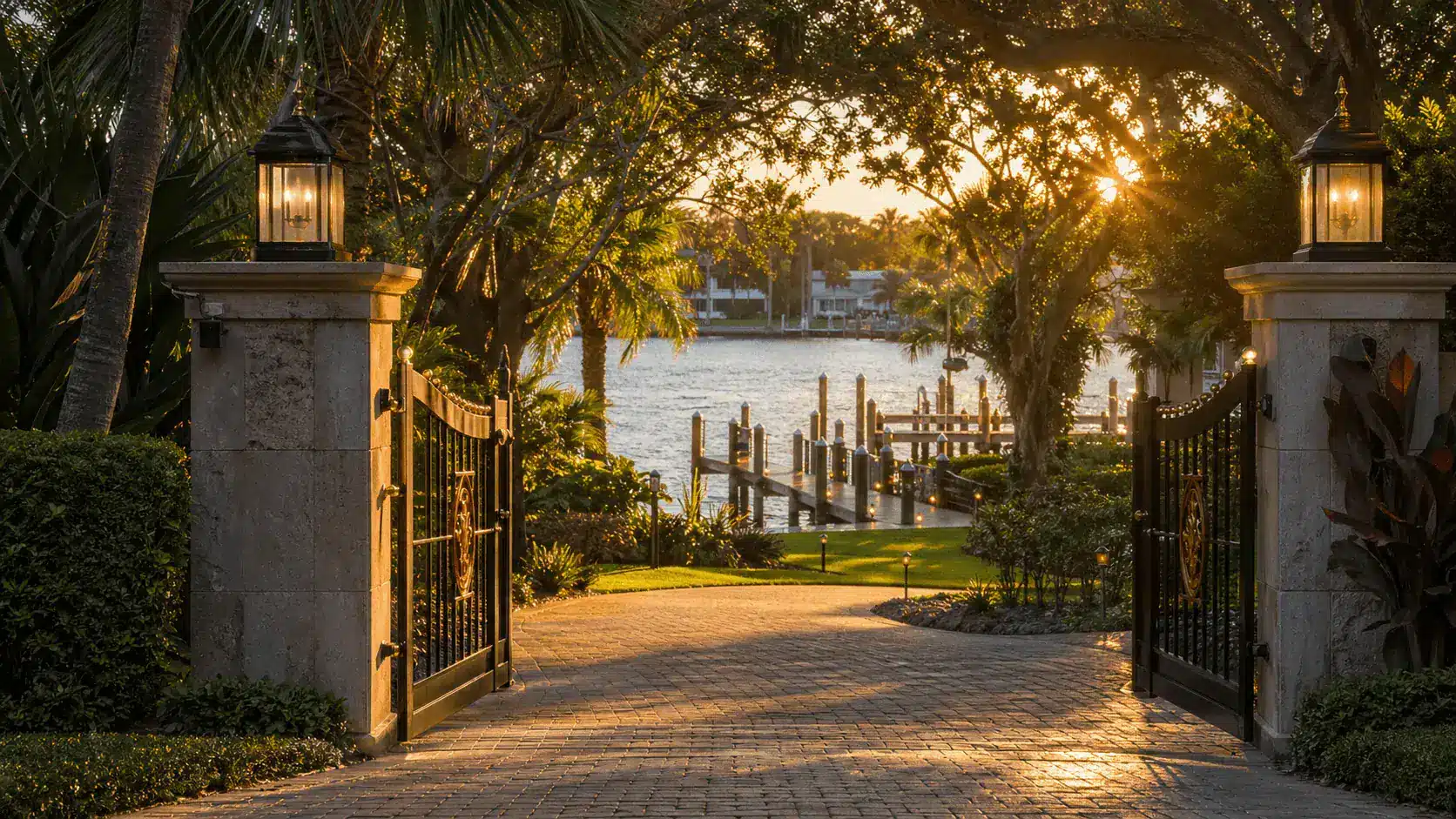
Waterfront properties in Jupiter face the same dual-perimeter challenge as Palm Beach Island, but the waterway environment is different. The Loxahatchee River is narrower and more enclosed than the Intracoastal at Palm Beach. The Jupiter Inlet creates tidal and current conditions that affect watercraft approaches. The marine-side security plan needs to account for these specific conditions.
Staff and contractor access on large properties
Jupiter estates typically employ fewer household staff than Palm Beach Island properties but more outdoor and property maintenance personnel. Landscaping crews servicing 5-acre lots, marine maintenance for boats and docks, equestrian staff for properties with horse facilities, pool services, pest control, and the general contractors who seem to be present continuously on properties of this size.
Each of these service providers represents an access vector. They’re on the property regularly. They know the layout. They observe routines. And in most cases, nobody is tracking their access with any more precision than “they come on Tuesdays.”
We build staff and contractor access management protocols for Jupiter estates that track who accesses the property, when, for how long, and what areas they’re authorized to enter. This isn’t surveillance — it’s the basic access management that any facility of this value should have and that most luxury residential properties in Jupiter don’t.
Seasonal considerations
Jupiter has a significant seasonal population. Many estates are occupied only during the winter months, with owners spending summers at residences in the Northeast, Mountain West, or internationally. The off-season vacancy creates the same exposure pattern as Palm Beach Island: 5-6 months of predictable absence at properties worth $10 million to $50 million or more.
Our seasonal transition protocols for Jupiter estates coordinate the shift from occupied to vacant status, establish off-season patrol and inspection schedules, manage the reduced staff footprint, and maintain security system integrity through the humid South Florida summer months that are particularly hard on electronic systems.
Contact
For an Estate Security Assessment in Jupiter, contact HKDS at +1 (561) 946-9843 or hkdef.com/contact-us/.