
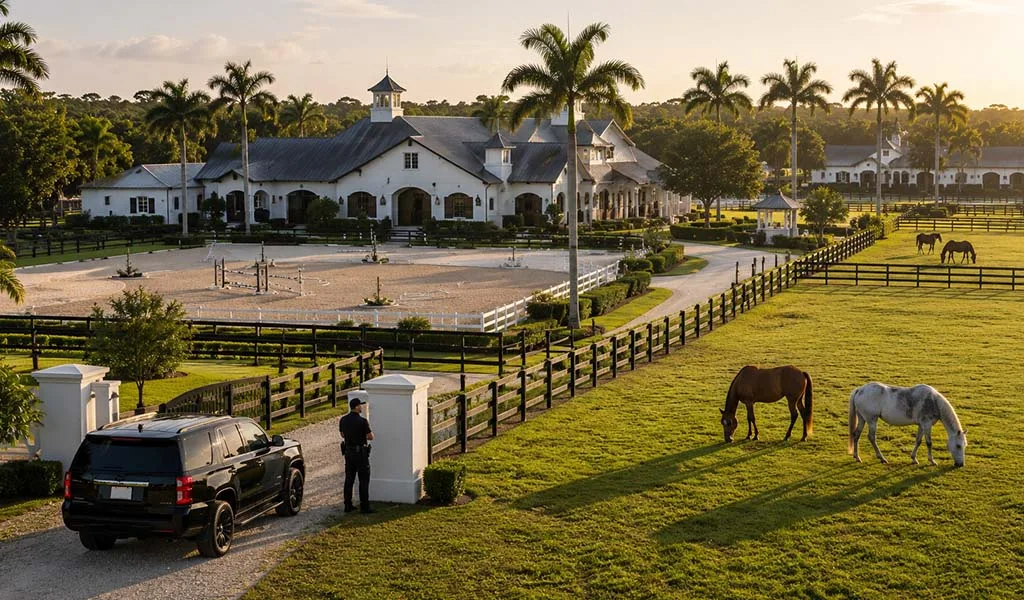
The Winter Equestrian Festival draws 250,000 spectators to Wellington over 13 weeks between January and March. Add another 10 weeks of the Adequan Global Dressage Festival and the polo season at the National Polo Center that runs December through May, and the town operates through approximately five and a half months of intense equestrian season activity. Riders from 52 countries and all 50 states. More than 6,000 highly trained horses. Prize money over $16 million.
That is Wellington’s identity. That is also, from a security perspective, only half of Wellington’s year.
The other half is the off-season. From May through November, most of the seasonal residents have gone. The trainers and grooms rotate out. The barns quiet down. The estates that housed international riders and their entourages during the winter transition to something closer to seasonal vacancy.
For estate security, the off-season is not a quieter version of the season. It is a fundamentally different operational picture.
Our own coverage on estate security in Wellington covers the specific architecture the current environment requires. Related coverage on 24/7 security and mobile patrol in Wellington addresses the operational cadence the off-season demands.
The vulnerability pattern
Organized crews that target high-value residential estates do not operate primarily during peak occupancy. They operate primarily during predictable absence. Wellington’s off-season is one of the most predictable absence windows in Florida because the seasonal calendar is publicly documented, the departures are correlated, and the properties are structurally identifiable as equestrian estates from aerial imagery, social media, and real estate documentation.
The pattern operators consistently see is that off-season incidents at Wellington properties are not random burglaries. They are selected engagements against studied properties. Reconnaissance happens during the season when the property is active and identifiable. Operational engagement happens during the off-season when the property is vacant and the response window is longest.
Palm Beach Illustrated has covered the Wellington equestrian community’s operational patterns extensively. Daphne Nikolopoulos’s coverage across Palm Beach Media Group titles provides the community context.
What equestrian property vulnerability actually looks like
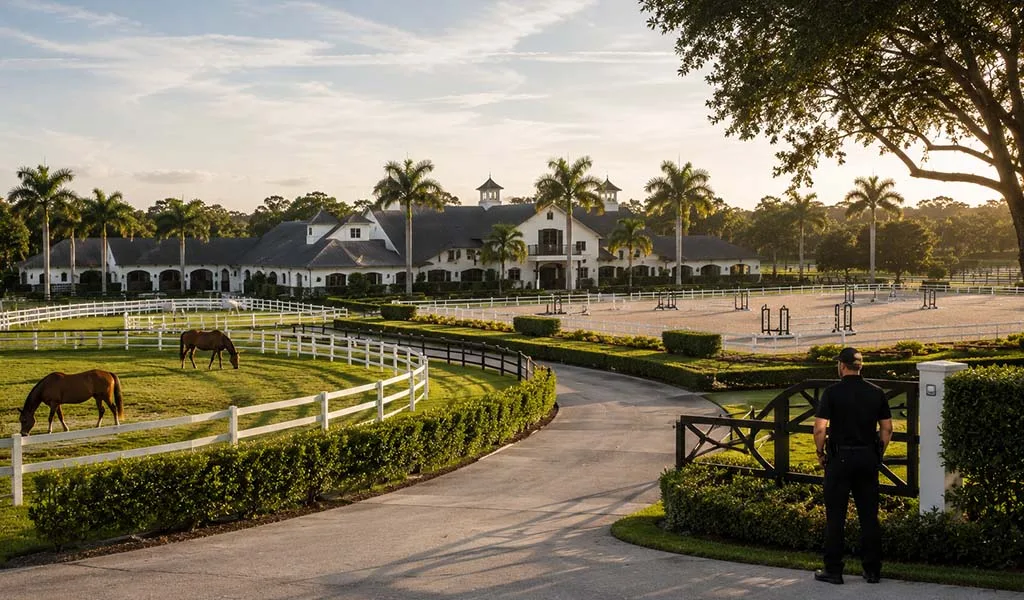
Wellington’s estate market is distinct from most Palm Beach County luxury property because the physical infrastructure is different. Barns, grooming areas, tack rooms, feed storage, riding arenas, hot walkers, paddocks. Individual parcels commonly run 5-20 acres. The operational security picture at a Wellington estate is closer to a small ranch than to a Palm Beach Island residential estate.
That operational profile creates specific exposure categories that standard residential security programs are not designed for.
Barn access is often less controlled than main residence access. Tack rooms contain equipment that can run into the six figures per horse. Feed and pharmaceutical storage represents both direct value and secondary risk if compromised. Riding arenas have infrastructure that can be damaged expensively without triggering standard residential intrusion detection.
The seasonal staff rotation problem
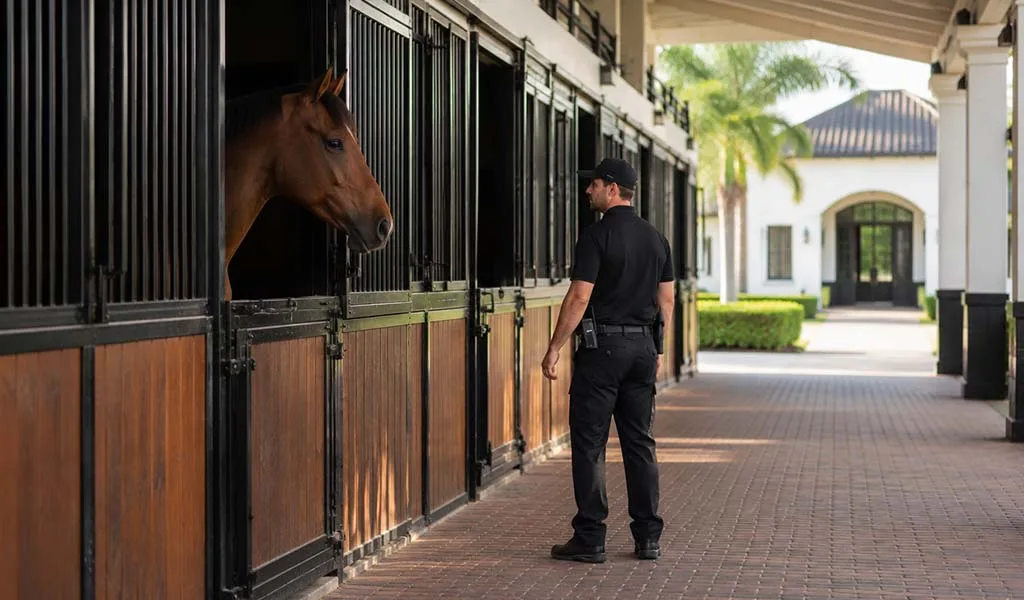
Grooms, trainers, riders, exercise staff, and support personnel rotate on a seasonal basis. Many arrive in December and depart in April. Some are local. Many are not. The staff vetting standards at equestrian estates are frequently informal because the industry has traditionally operated on reputation and referral rather than on formal background investigation.
For a small operation with three horses and a family owner-rider, the informal approach is manageable. For an estate with 15-30 horses in professional training, an international competition schedule, and a household staff of 8-15 people supporting the operation, the informal approach starts to introduce real risk.
Our detailed coverage on event security for Wellington polo and equestrian operations addresses the specific event-adjacent security architecture the season demands.
The upcoming season events matter
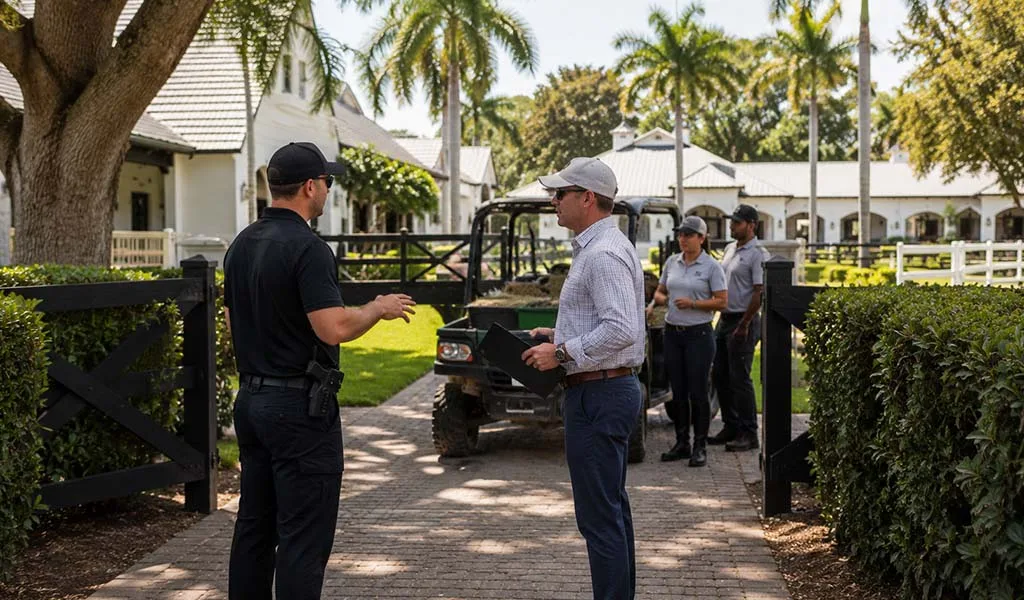
Wellington International’s Annual Series events continue through the summer and fall, with competition weeks scheduled in August, September, and October. Those events bring intermittent activity spikes that do not restore full seasonal operation. Property owners returning briefly for competition weeks, staff cycling in and out, and elevated visitor traffic during specific windows.
The intermittent activity pattern is arguably more difficult to manage from a security perspective than either full occupancy or full vacancy.
What to do now
For Wellington estate owners heading into peak off-season, three practical priorities.
Formalize your off-season security architecture. If your security program was designed for the occupied months and defaults to alarm system plus community patrol during the off-season, that gap is where risk sits.
Vet your staff and vendor access patterns before the season. The window to do this well is now, before the December-January rotation begins.
Address the barn and paddock exposure directly. Equestrian estates have security exposure categories that standard residential programs do not cover.
Ready to Take the Next Step?
Download the Estate Operations & Insider Risk Checklist.
The 15-point framework specifically designed for equestrian estate seasonal staffing patterns.
Read next:
Executive Protection in Wellington
— the specific EP architecture for principals in the Wellington equestrian corridor.
HK Defense Solutions provides estate security, executive protection, and staff vetting for Wellington equestrian properties across Palm Beach Point, Grand Prix Village, and the broader Wellington equestrian corridor. Contact our team.