
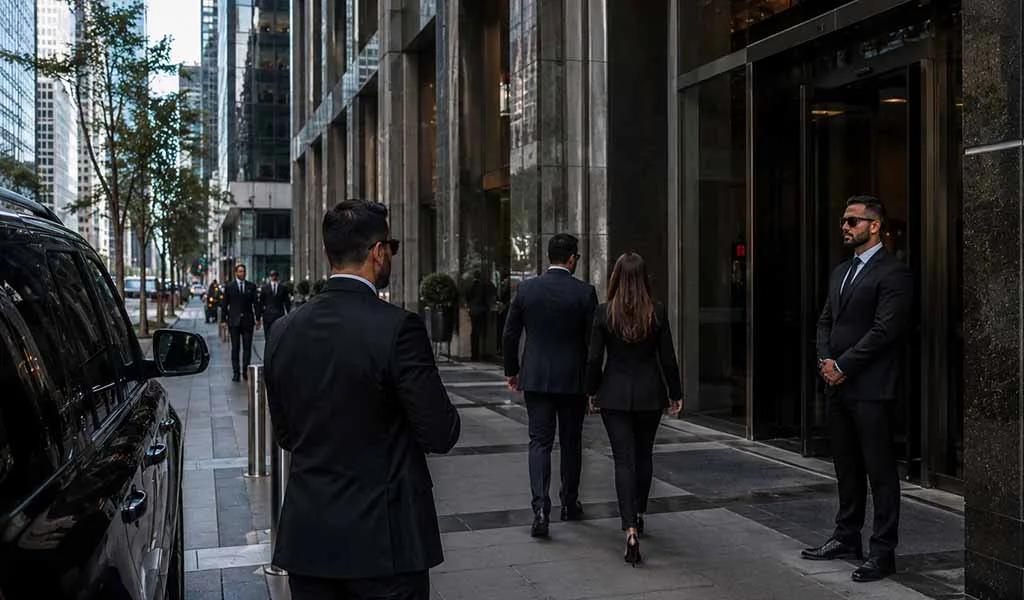
The murder of UnitedHealthcare CEO Brian Thompson outside the New York Hilton Midtown on December 4, 2024 transformed corporate executive protection in a way no incident in recent memory had done. Eighteen months later, the changes have hardened into structural expectations that will not reverse regardless of what happens next.
The shift matters most in Manhattan because Manhattan is where the concentration of corporate executives, financial services principals, and public figures produces the density of exposure the Thompson incident exposed. It matters second-most in the Palm Beach County corridor because the seasonal migration pattern of Manhattan principals means the same executives who require protection in New York from October through May require it in Palm Beach from November through April.
What has actually changed
According to the October 2025 World Security Report commissioned by Allied Universal, 97 percent of global institutional investors say companies should invest in security for their executives. Nearly half of security chiefs report they have enhanced security procedures. 44 percent are monitoring online threats. 40 percent offer training and preparedness for leaders. 35 percent provide leaders with personal close protection personnel.
Corporate boards that used to treat executive protection as a discretionary perk now treat it as a governance obligation with SEC disclosure implications, D&O insurance considerations, and proxy scrutiny standards. Our own analysis of why boards must prioritize CEO protection covers the governance framework specifically.
Prior to December 2024, the specific corporate governance question that Fortune 500 boards face at nearly every risk review was answered informally. Post-December 2024, the answer requires documentation, methodology, and reporting frameworks that satisfy institutional scrutiny.

The Manhattan operational picture
Manhattan’s specific operational picture involves several factors that combine into the exposure profile Thompson’s killing exposed.
Corporate concentration is extreme. The number of Fortune 500 headquarters, financial services firms, and public company senior leadership residing or working in Manhattan is greater than in any other single city globally. The Billionaires Row corridor along 57th Street includes Central Park Tower, 220 Central Park South, 111 West 57th Street, One57, and the Aman New York Residences, producing perhaps the single most concentrated corridor of ultra-high-net-worth residential real estate on the planet.
Public exposure is unavoidable. Executives named on SEC filings, photographed at conferences, and increasingly targeted through public appearance schedules face a level of documented visibility that is structurally different from private principals in Palm Beach or Miami.
Density creates operational complexity. Manhattan residential security operates within shared buildings where management-level security does not protect individual residents. Private floor security, staff vetting, and building integration fill the gap for UHNW condo and co-op owners with elevated threat profiles.
The 2026 FIFA World Cup overlay
The specific mid-summer 2026 environment adds another layer to the Manhattan operational picture. The 2026 FIFA World Cup is holding matches at MetLife Stadium in the New York/New Jersey area through June and July. The concentration of international visitors, elevated security infrastructure, and public event activity produces both direct protective operations and secondary effects on the broader executive protection environment.
For Manhattan corporate executives whose principal profile includes public appearances during this window, the operational picture is more constrained than normal. Public event security is elevated across the region. Our specific coverage on executive protection for World Cup visitors moving between Miami and Palm Beach addresses the cross-market movement pattern.
The seasonal migration reality
A significant share of Manhattan UHNW principals maintain residences in the Palm Beach County corridor. The seasonal migration pattern southbound in October-November, northbound in April-May, creates a security transition twice each year that most standard programs do not handle well.
The fragmentation between separate New York and Florida security providers produces gaps at every transition point. Threat intelligence does not transfer. Standing operational relationships do not transfer. Household staff patterns require re-establishment. Vendor access patterns start over.
The households that manage the seasonal transition well tend to run parallel operations under one command structure across both markets. Our own Manhattan-Palm Beach corridor coverage addresses the specific integrated architecture.

What to do now
For Manhattan executives and UHNW principals, the practical priorities in mid-2026 are consistent with the broader post-Thompson environment.
Assess whether your executive protection architecture matches the current governance environment. If your corporate role requires EP but your current arrangement is informal or under-documented, the governance question will be raised at the next risk review whether you initiate it or not.
Address the residential security gap specifically. Building-level security is not sufficient at the concentrated-wealth tier.
If you maintain a Palm Beach County residence, integrate your Manhattan and Florida operations under one command structure.
If your last comprehensive executive protection review predates December 2024, the review is now overdue by definition.
Ready to Take the Next Step?
Download the Founder Security Checklist.
The 15-point framework specifically designed for high-visibility corporate leadership.
Read next:
Adaptive Private Security for Changing Threats in New York
— the New York-specific architecture that addresses the post-Thompson environment.
HK Defense Solutions provides executive protection, corporate security, and residential security across Manhattan, all NYC boroughs, Westchester County, and the Hamptons. Contact our team.