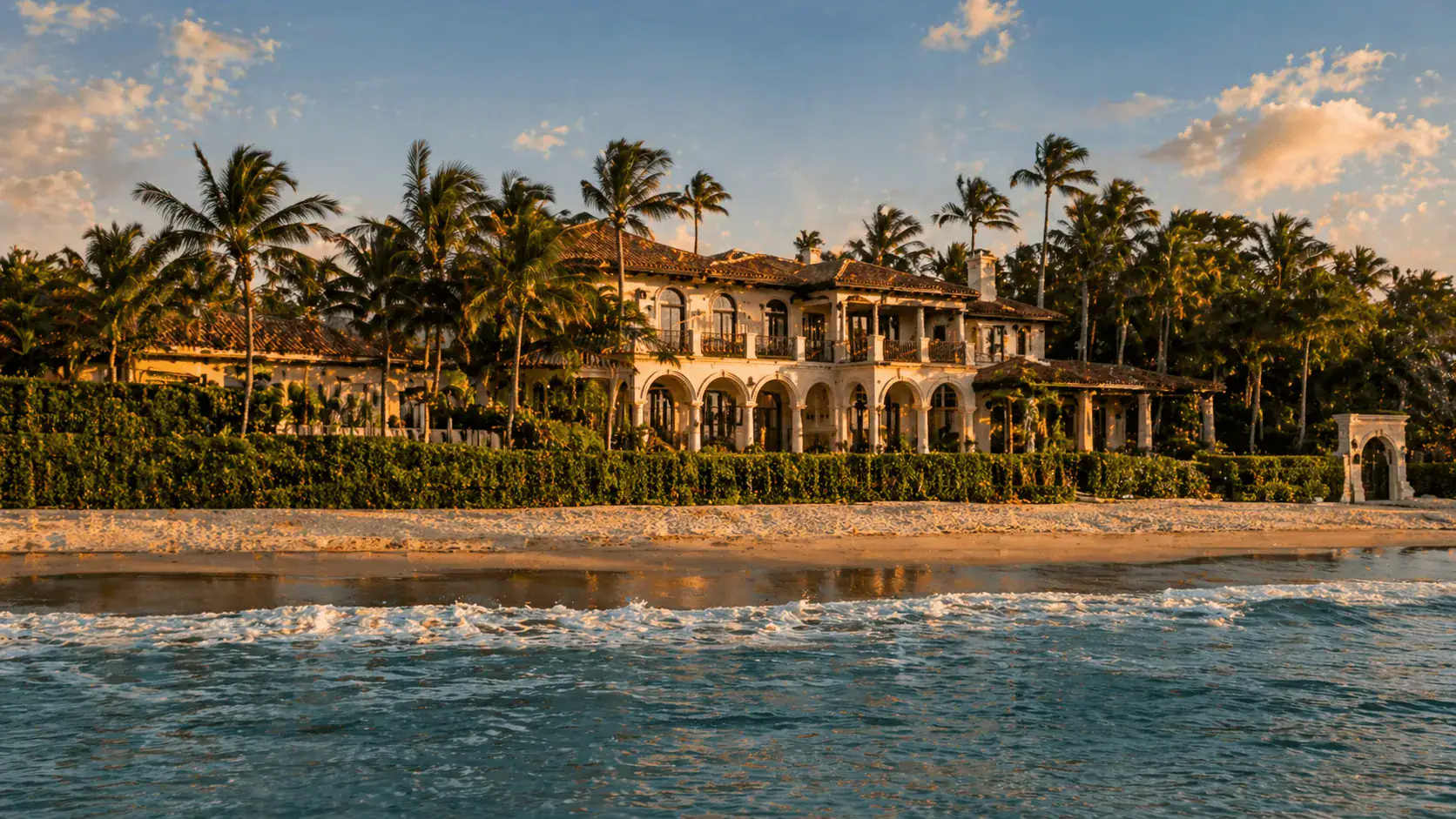
An estate on Palm Beach Island is not a house with a fence around it. It’s an operational environment with at least two perimeters (ocean and Intracoastal), a rotating staff of 5 to 30 people depending on the property, a smart home infrastructure with 40 to 100 connected devices, and an owner whose net worth makes the property a permanent target regardless of whether they’re in residence.
Most estate security programs on the island were designed around a simpler premise: keep unauthorized people from walking through the front gate. That was adequate when the primary threat was an opportunistic burglar testing door handles. In 2026, it’s not adequate for any property valued over $10 million — and on Palm Beach Island, that describes nearly all of them.
The dual-perimeter reality
Every estate on Palm Beach Island has at least one side facing water. Properties on the ocean side have beach exposure that extends to the high-water mark — technically public access. Properties on the Intracoastal side have dock access that’s reachable by any vessel on the waterway. Properties that span the full width of the island have both.
This means the traditional gate-and-alarm model protects, at best, half the property’s perimeter. The waterfront exposure — where someone can approach by boat, kayak, jet ski, or drone without encountering a gate, a guard, or a camera — is the vulnerability that most estate security programs on the island leave completely unaddressed.
We assess and design marine-side security for Palm Beach Island estates as a standard component of every engagement. This includes camera coverage oriented toward waterfront approaches, sensor networks that detect activity on docks and seawalls, counter-drone detection for overflights from the ocean, and protocols for responding to unauthorized watercraft approaches.
The staff vetting imperative
Palm Beach Island estates employ large household staffs. Housekeepers, personal chefs, drivers, gardeners, pool technicians, personal assistants, nannies, tutors, property managers, and in some cases live-in security personnel. Many of these individuals carry keys, know alarm codes, have access to private spaces, and connect personal devices to the estate’s Wi-Fi network.
The deed theft epidemic currently affecting Palm Beach County — cases surged 4,500% from 2023 to 2025 — adds another dimension. Property fraud in Florida exploits public records. But the personal information needed to attempt more sophisticated attacks against a principal often comes from people with inside access. A housekeeper who mentions the family’s travel schedule to a friend. A driver who posts photos of the estate’s interior on social media. A former employee who still has the gate code because nobody changed it when they left.
We build comprehensive staff vetting and insider risk management protocols for Palm Beach Island estates covering initial background investigation, periodic re-screening, device policies, social media restrictions, NDAs, and structured off-boarding procedures. This isn’t a one-time background check. It’s an ongoing program that accounts for the reality that people’s circumstances change and that access needs to be managed continuously.
Smart home vulnerability
The luxury estates built or renovated on Palm Beach Island in the last decade are among the most technologically sophisticated homes in the country. Crestron or Savant whole-home automation. Lutron lighting. Sonos or similar distributed audio. Security cameras from multiple manufacturers. Smart locks on interior and exterior doors. Climate control systems. Pool and landscape automation. Voice assistants in multiple rooms.
In most assessments we conduct, the network architecture underlying all of this is either flat (everything on one network) or segmented improperly (security cameras on the same VLAN as guest Wi-Fi). The implications are significant. A vulnerability in any connected device can potentially provide access to the security camera system. A compromised voice assistant can potentially listen to conversations in the principal’s private spaces. A contractor who connects to the guest Wi-Fi can potentially see devices on the security network.
We audit and remediate network architecture for Palm Beach Island estates. Network segmentation, device inventory, credential management, firmware oversight, and the physical separation of security-critical systems from consumer and guest networks.
Seasonal transition
The transition from occupied to vacant — typically April through May — is the most vulnerable period for Palm Beach Island estates. The principal departs. The full-time staff reduces to a skeleton crew or vacates entirely. The property enters a 5-6 month vacancy that is observable to anyone watching: lights stop turning on, vehicles disappear from the driveway, the activity pattern changes visibly.
We build seasonal transition protocols that maintain the appearance of occupancy, ensure that physical security remains active throughout the vacancy, coordinate property checks with remaining staff or service providers, and integrate property records monitoring against the deed theft threat that targets vacant properties specifically.
Contact
For an Estate Security Assessment on Palm Beach Island, contact HK Defense Solutions at +1 561 510 8221 or hkdef.com/contact-us/ .