
Armed transport services are one of the most misunderstood categories in private security. Most principals think of them as “a guy with a gun in a black SUV.” That mental picture is wrong, and it is also why so many armed transport services fail the people who hire them.
For ultra-high-net-worth families operating between Palm Beach, Miami, Greenwich, Manhattan, and the Hamptons, armed transport is not a vehicle service. It is a moving security perimeter that has to function flawlessly across jurisdictions, traffic patterns, threat environments, and personal routines. When that perimeter is built correctly, nothing interesting ever happens. When it is built poorly, the failure shows up at the worst possible moment.
HK Defense Solutions has operated armed transport services across Florida, the Northeast luxury corridor, and international environments since John Hamilton founded the firm after twelve years in U.S. Air Force special operations. This article breaks down what armed transport services actually include, where most providers fall short, and what UHNW principals and their family offices should be looking for.
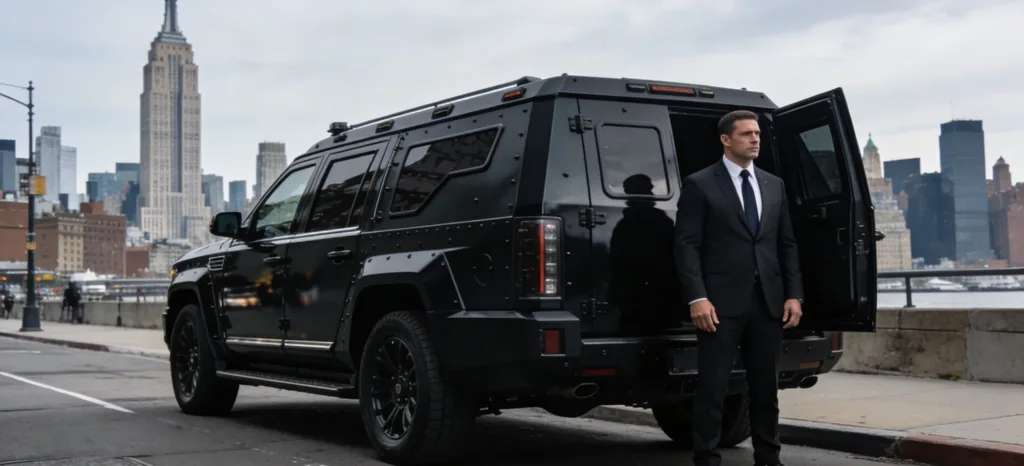
What Armed Transport Services Actually Mean
The phrase “armed transport services” covers a wider operational range than most people realize. At the most basic end, it means a licensed protective driver carrying a concealed firearm while operating a soft-skin vehicle. At the high end, it means a coordinated multi-vehicle movement using armored platforms, advance teams, counter-surveillance operators, real-time intelligence monitoring, and medical support.
The correct answer for any given principal sits somewhere on that spectrum. It depends on threat profile, route geography, media exposure, family composition, and the realistic failure modes for the movement being planned. A family office chief of staff booking armed transport services for a principal’s weekly Palm Beach to Miami trip is solving a different problem than a corporate security director arranging armed transport for a CEO traveling through a contested international environment.
Real armed transport services include route planning, choke point analysis, secondary and tertiary escape routing, vehicle inspection protocols, driver medical and firearms requalification, communications discipline, and coordination with local law enforcement when appropriate. The vehicle and the firearm are the last two percent of the capability. Everything before them is what actually keeps the principal safe.
Why Most Armed Transport Services Fail
Most armed transport services in the Florida and New York markets fail for the same reason: the provider sells optics instead of outcomes. You get a large man in a dark suit, a black Suburban, and a holstered pistol. What you do not get is advance work, route variation, counter-surveillance awareness, or integration with the rest of the principal’s security program.
That gap is where exposure lives. An attacker planning a targeted incident against a UHNW principal does not care how the driver looks. They care whether the route is predictable, whether the vehicle is scanned before each movement, whether the driver is trained to recognize surveillance, and whether the team has a rehearsed response to a blocked intersection or a medical emergency in the vehicle.
Armed transport services that ignore those questions are selling a costume. They pass the visual inspection of the family office or estate manager but collapse the moment a real incident begins to form. The principal is no safer than if they had taken a rideshare.
The HKDS Standard for Armed Transport
HK Defense Solutions builds armed transport services as one integrated layer inside a converged protection program. That means the drivers operating the vehicles are cross-trained in protective intelligence, emergency medicine, and low-visibility protective detail work. The vehicles themselves, whether soft-skin executive sedans or armored SUVs, are maintained under a documented inspection protocol and rotated to prevent pattern exposure.
Every movement begins with an advance. A member of the team drives the route before the principal moves, identifies construction, events, or other pattern disruptors, and updates the primary and alternate routing accordingly. For recurring movements such as school runs, office commutes, or standing appointments at Palm Beach medical facilities, the team rotates timing windows and entry points to avoid creating a fixed pattern an attacker could exploit.
Communications discipline is enforced on every detail. Open-air radio traffic, unencrypted phone calls, and social media posts by staff are all treated as operational security violations. The principal’s itinerary never leaves the protected circle unless there is a documented operational need.
Armored Vehicles, Soft-Skin, and the Decision That Matters
A common question from principals new to armed transport services is whether they need armored vehicles. The honest answer is that most UHNW principals in Florida and New York do not need armored vehicles most of the time. An armored platform adds weight, reduces maneuverability, draws attention, and costs significantly more to acquire, maintain, and insure.
Armored vehicles earn their place when the threat profile includes a credible targeted attack risk, when travel routes include hostile environments, or when the principal is a public figure whose movements are actively tracked by media or activists. For a hedge fund principal moving between a Palm Beach estate and a West Palm Beach office, a trained protective driver in a well-maintained soft-skin SUV will outperform an armored vehicle driven by an untrained contractor every time.
HK Defense Solutions maintains both armored and soft-skin platforms and selects the right one based on threat assessment rather than sales incentive. That distinction matters because some providers push armored vehicles on every client regardless of need, because armored vehicles carry higher margins.
Geographic Considerations: Florida, New York, and the Corridor In Between
Armed transport services in Florida operate under different legal and practical constraints than they do in New York or Connecticut. Florida concealed carry reciprocity is broader than New York’s. Traffic patterns in Palm Beach and Miami reward different driving techniques than Manhattan’s grid or the Hamptons’ seasonal congestion. Law enforcement relationships are structured differently across jurisdictions.
A capable armed transport provider understands these differences and plans accordingly. For principals who move regularly between Palm Beach and New York, the transport team needs licensing, vehicle registration, and operational procedures that work in both environments. For principals who travel onward to Greenwich, Aspen, or international destinations, the provider needs a proven network that extends those capabilities without sacrificing standards.
HK Defense Solutions coordinates armed transport movements across Florida, the Northeast, and international environments using a mix of direct operational teams and vetted partner networks. The standard does not change at the state line.
What to Look For When Hiring Armed Transport Services
If you are a family office, chief of staff, or estate manager evaluating armed transport services for a principal, the qualifying questions are straightforward. Ask about driver selection standards. Ask how often drivers requalify on firearms and emergency vehicle operations. Ask how advance work is conducted and documented. Ask how the provider integrates with the rest of your principal’s security program, including residential security, protective intelligence, and cyber monitoring.
If the provider cannot answer those questions with specificity, you are not looking at armed transport services. You are looking at a rental car with a firearm inside.
HK Defense Solutions offers a Private Threat Mapping Session for families, offices, and corporate security directors who want to understand where their current transport program is exposed. The session is conducted with John Hamilton and produces a documented assessment of current coverage gaps and recommended remediation.
To schedule a Private Threat Mapping Session, apply at hkdef.com. For a self-guided starting point, download the HKDS Converged Digital Exposure Checklist and the Board-Level Risk and Continuity Oversight Checklist from the downloads section of our website.
Armed transport services done correctly are invisible. That is how you know they are working.
Regional Considerations: Florida to New York Luxury Corridor
Armed transport services across the Florida-to-Northeast corridor require distinct planning discipline at each node. In Palm Beach County, the routing problem is less about congestion and more about predictability. Principals who follow identical patterns between their Manalapan estate, Palm Beach Island residence, and Jupiter Island compound create exploitable routines that any competent hostile surveillance team can document within a week. Armed transport services worth paying for rotate routes, stagger departure windows, and use counter-surveillance detection on recurring movements.
In Miami and Miami Beach, the threat environment shifts. Traffic density, international criminal exposure, and the sheer volume of luxury vehicles in places like Brickell, Fisher Island, Star Island, and Indian Creek mean that principals are harder to spot but also harder to move cleanly. Armed transport services in Miami need detailed knowledge of local choke points, hotel loading zones, restaurant back-of-house access, and marina transfer points.
The Greenwich, Manhattan, and Hamptons corridor introduces a different operational problem entirely. Manhattan traffic makes armored SUV movements loud and obvious. Discreet armed transport services in the Northeast often rely on smaller vehicles, rotating platforms, and tighter protective details rather than convoy formations. Principals crossing into Greenwich from Midtown, or running up to East Hampton on weekends, need armed transport services that understand the differences between New York state firearms licensing, Connecticut reciprocity, and the coordination required to operate legally across state lines.
Frequently Asked Questions
How much do professional armed transport services cost?
Do I need armored vehicles or will soft-skin vehicles work?
How far in advance should I book armed transport services?
Can armed transport services coordinate with my existing residential security team?
How HK Defense Solutions Approaches Armed Transport
HK Defense Solutions builds armed transport services around the converged security model John Hamilton developed after twelve years in U.S. Air Force special operations. That means every movement is backed by protective intelligence analysis, every operator is medically capable, every vehicle is inspected before use, and every route is reviewed against current threat reporting.
For family offices evaluating armed transport services in Florida, New York, or any of the luxury corridors in between, the right starting point is a private threat mapping session with John Hamilton. That conversation identifies the actual exposure profile before anyone quotes a vehicle count or an operator number. To book a session, visit hkdef.com. Family offices and chiefs of staff should also download the Board-Level Risk and Continuity Oversight Checklist and the Converged Digital Exposure Checklist to benchmark current arrangements against what operator-grade armed transport services should deliver.