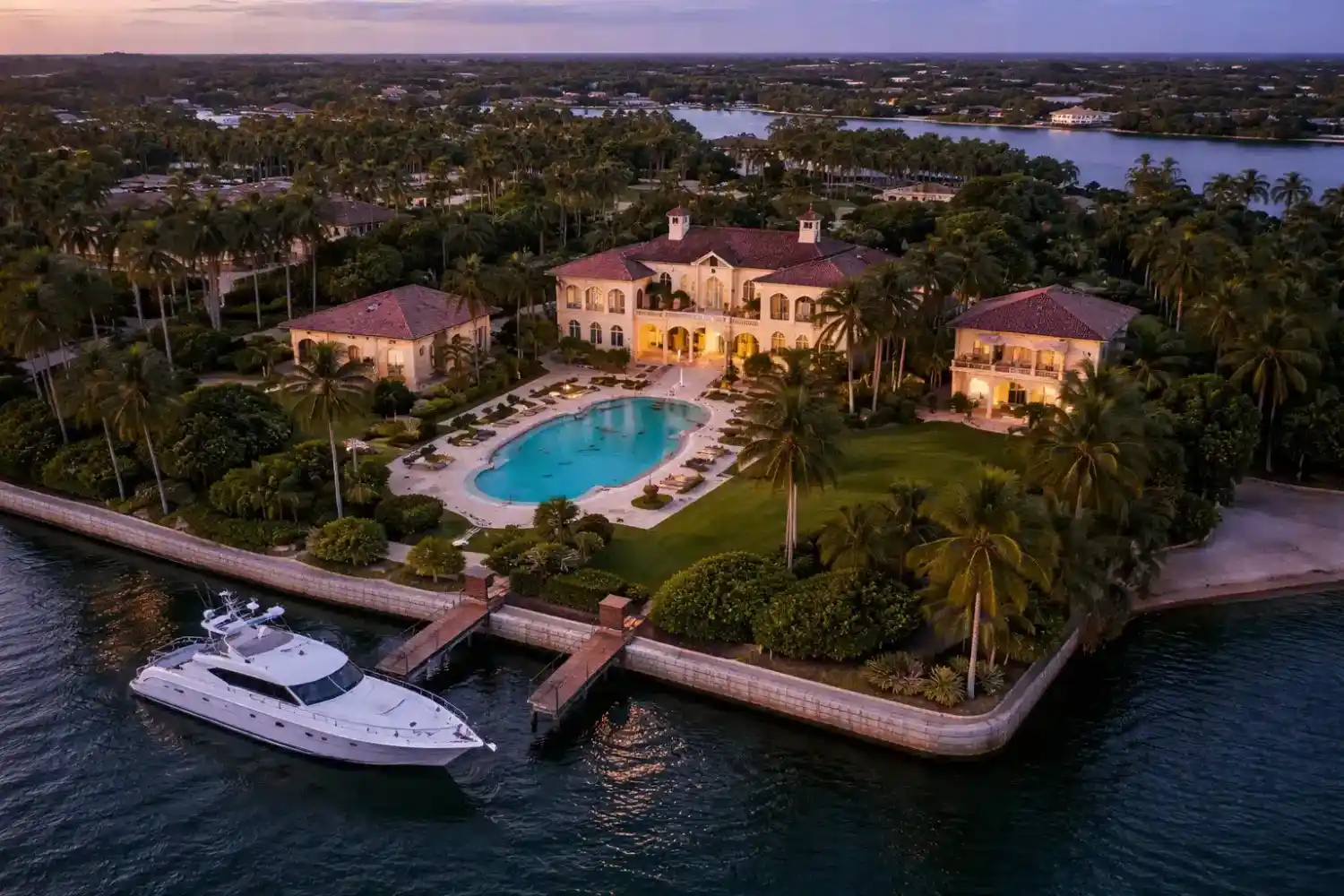
Complex residences are not built like standard homes. They stretch across multiple structures, span waterfronts, include detached guest houses, staff quarters, private docks, equestrian facilities, art vaults, or underground garages. In areas such as Palm Beach, Jupiter, and Wellington, estates often function more like private compounds than single-family homes.
That’s why estate security consulting is not about installing a few cameras or hiring a guard. It is about designing a layered, lifestyle-aligned protection strategy for non-standard layouts where visibility gaps, access complexity, and operational blind spots create real exposure.
This guide explains how estate security consulting works for complex properties—and how to approach protection without compromising privacy, aesthetics, or daily life.
The Hidden Risk in Non-Standard Estates
Traditional residential security models assume:
- One main structure
- Predictable entry points
- Clear sight lines
- Minimal staff rotation
Complex estates break all of these assumptions.
Consider properties in Manalapan or Palm Beach Island that include:
- Waterfront access (dock or beach exposure)
- Multiple gated entrances
- Service/vendor access lanes
- Detached guest homes
- Landscaping that obstructs the line of sight
- Event hosting areas
Security gaps do not appear because owners are careless. They appear because growth outpaces design. Renovations, additions, and lifestyle upgrades create security blind spots that were never assessed holistically.
This is where estate security consulting becomes critical.
Who This Is For
You are a principal, family office, estate manager, or executive homeowner who:
- Has invested significantly in property and privacy
- Hosts guests, events, or high-profile visitors
- Employs household staff or rotating vendors
- Owns assets on-site (art, vehicles, collectibles)
- Travels frequently
You want peace of mind.
You want discretion.
You want protection that does not feel intrusive.
You may have:
- Installed systems over time without a unified strategy
- Hired guards without a formal risk assessment
- Assumed gated access was “enough”
- Expanded the estate without updating protocols
You may suspect that your current setup was never designed as a cohesive security ecosystem.
You’re probably right.
The Core Concept
Here’s the truth:
You can secure a complex estate without turning it into a fortress.
However, most properties remain vulnerable because security is installed in pieces—cameras here, gates there—without a comprehensive threat model tied to layout, behavior patterns, and exposure.
Professional estate security consulting aligns architecture, technology, personnel, and procedures into one coordinated system designed around how the residence actually functions.
Step 1: Conduct a Layout-Driven Threat Assessment
The old way:
Install cameras where it “looks right.” Add guards after an incident. React to problems.
The result:
Unmonitored approach routes. Poor lighting in corridors. Staff credential gaps. Waterfront blind spots.
The new way:
Begin with a comprehensive threat and vulnerability assessment tied directly to the estate’s physical layout.
What This Involves
- Mapping every access point (primary, secondary, informal)
- Identifying natural concealment zones
- Reviewing staff and vendor movement patterns
- Evaluating public visibility exposure
- Assessing perimeter depth and delay capability
Unique Insight
Security failures in large residences rarely occur at the main gate.
They occur at transitional zones—side paths, service entrances, dock access, detached structures—where ownership boundaries blur and monitoring weakens.
A structured estate security consulting process identifies these micro-vulnerabilities before they are exploited.
Step 2: Design Layered, Bespoke Residential Security Architecture
The old way:
Rely heavily on visible deterrence—large gates, obvious cameras, armed presence.
The result:
Aesthetic disruption. Guest discomfort. Operational rigidity.
The new way:
Implement bespoke residential security solutions tailored to the estate’s architecture and lifestyle.
Layered protection typically includes:
- Perimeter Security
- Smart access control
- Vehicle screening protocols
- Intrusion detection along fence lines
- Intermediate Zone Protection
- Motion analytics
- Thermal or low-light surveillance for waterfront or wooded areas
- Strategic lighting placement
- Structure-Level Security
- Controlled interior zones
- Panic and safe room planning
- Integrated alarm systems
- Operational Protocols
- Visitor verification procedures
- Staff vetting and access control hierarchy
- Delivery management workflows
Unique Insight
Technology without protocol fails.
Even the most advanced surveillance system is ineffective if:
- Alerts are not monitored in real time
- Staff are untrained in escalation procedures
- Vendor access is inconsistently managed
True estate security consulting merges hardware with human behavior design.
Step 3: Integrate Personnel Without Disrupting Lifestyle
The old way:
Add security personnel only after a visible incident or media exposure.
The result:
Reactive posture. Inconsistent training. Guards unfamiliar with the estate layout.
The new way:
Deploy security personnel based on structured risk modeling and estate usage patterns.
In areas like Ft. Lauderdale and North Palm Beach, estates often support:
- Seasonal occupancy
- Yacht docking operations
- Event hosting
- Multi-family living
Personnel strategy may include:
- Static post guards
- Mobile patrol units
- Discreet executive protection
- Event-specific security teams
Unique Insight
Security presence must match the rhythm.
An estate that hosts large gatherings monthly requires scalable response protocols.
A family that travels internationally requires remote monitoring and rapid deployment capability.
Estate security consulting aligns protection with lifestyle tempo—not just square footage.
Common Mistakes in Complex Residences
1. Overreliance on Gated Access
Gated communities reduce casual traffic—but do not eliminate targeted threats.
2. Underestimating Waterfront Exposure
Docks and beach access create alternate approach vectors often left unmonitored.
3. Unstructured Staff Access
Long-term household staff may accumulate unrestricted access over time without formal review.
4. Technology Without Redundancy
Single-point failures (power loss, network disruption) leave entire estates exposed.
5. No Incident Response Plan
Without a rehearsed plan, even minor security events escalate into chaos.
Case-Based Scenario: Complex Waterfront Estate
State 1:
Waterfront estate with two gates, dock access, detached guest house, rotating vendors, and no centralized monitoring.
State 2:
Layered security architecture with access zoning, credential hierarchy, dock surveillance, and unified monitoring dashboard.
Timeframe:
Phased implementation over 90 days.
Result:
Reduced exposure, structured visitor management, improved family confidence, and no disruption to daily routine.
The transformation wasn’t about adding visible force.
It was about implementing structured estate security consulting principles across the entire property ecosystem.
Option 1: The Hard Way
Attempt to coordinate:
- Separate alarm contractors
- Independent guard services
- Ad hoc camera installations
- Informal staff protocols
This often results in:
- Fragmented systems
- Blurred accountability
- Higher long-term costs
- Delayed response capability
Complex residences demand integrated thinking, not piecemeal upgrades.
Option 2: Structured Estate Security Consulting
Working with a specialized team provides:
- Formal threat assessment
- Customized security design
- Integrated technology recommendations
- Personnel strategy development
- Ongoing advisory and review
At HK Defense Solutions, estate security consulting is built around:
- Discretion
- Architectural sensitivity
- Threat-informed design
- Operational continuity
The objective is not intimidation—it is controlled stability.
Benefits of Professional Estate Security Consulting
When properly implemented, you will:
- Gain full visibility across all access points
- Establish controlled staff and vendor access
- Protect the waterfront and secondary structures
- Reduce liability exposure
- Increase confidence during travel
- Host events without compromising safety
You can finally remove the uncertainty of “What are we missing?”
You can forget about reactive upgrades after minor incidents.
You will feel assured because your estate operates under a structured protection framework—not assumptions.
How the Process Works
1. Initial Consultation
Confidential discussion of estate layout, concerns, and lifestyle patterns.
2. On-Site Assessment
Comprehensive evaluation of architecture, terrain, access, and operational flow.
3. Strategic Design Plan
Detailed roadmap covering technology, personnel, and protocol layers.
4. Implementation Oversight
Coordination with contractors, system integrators, and estate management.
5. Ongoing Review
Periodic reassessment as estate usage evolves.
Frequently Asked Questions
What makes estate security consulting different from standard home security?
Standard systems focus on intrusion alarms. Estate security consulting evaluates the entire property ecosystem—layout, access hierarchy, staffing, and exposure vectors.
Is bespoke residential security intrusive?
Not when designed correctly. The goal of bespoke residential security is seamless integration into architecture and lifestyle, maintaining privacy while enhancing protection.
How often should complex estates be reassessed?
At a minimum, annually, or after major renovations, staffing changes, or public exposure increases.
Does gated community living eliminate the need for structured security?
No. Gated environments reduce casual risk but do not address targeted threats or internal operational vulnerabilities.
The Bottom Line
Complex estates require more than surface-level protection.
If your residence includes multiple structures, waterfront exposure, event hosting, or high-value assets, it may be time for a structured review.
Schedule a confidential consultation with us to evaluate how estate security consulting can protect your property without compromising your lifestyle.
Estate security is not about visible force.
It is about intelligent design, layered control, and discreet stability—engineered specifically for complex residences.