Recent high-profile incidents involving corporate executives have forced boards and security leaders to confront an uncomfortable reality: traditional security programs are no longer sufficient. When UnitedHealthcare CEO Brian Thompson was killed in December 2024, the question wasn’t whether security existed—but whether it was designed to anticipate modern, multi-domain threats.
Executive protection explained properly is not a reaction to incidents. It is a risk-based system designed to identify threats early, reduce executive exposure, and coordinate physical, digital, and operational controls before risk escalates.
Too many organizations still rely on fragmented security models. Cyber teams manage digital threats, physical security focuses on access control, and intelligence functions operate in isolation. When threats move across domains—as they increasingly do—these silos create dangerous gaps.
This article explains executive protection through a structured, risk-based framework and outlines how organizations can build protection as an integrated system rather than a collection of disconnected services.
Understanding Modern Executive Protection as a Risk-Based System
Executive protection explained simply is the practice of safeguarding organizational leadership by identifying threats early, reducing exposure, and coordinating physical, digital, and operational controls into a single system. Unlike traditional security, it is proactive, intelligence-led, and continuously evolving.
Consider this: a disgruntled activist researches an executive online and discovers their daily commute pattern through geo-tagged social media posts. They identify the executive’s home address through public records and monitor travel plans.
By the time this person shows up at the executive’s residence or office, multiple systems have failed—not because they didn’t work, but because they weren’t designed to work together.
Traditional security measures address individual threat vectors but miss the convergence where real danger emerges. An effective EP framework must bridge these gaps.
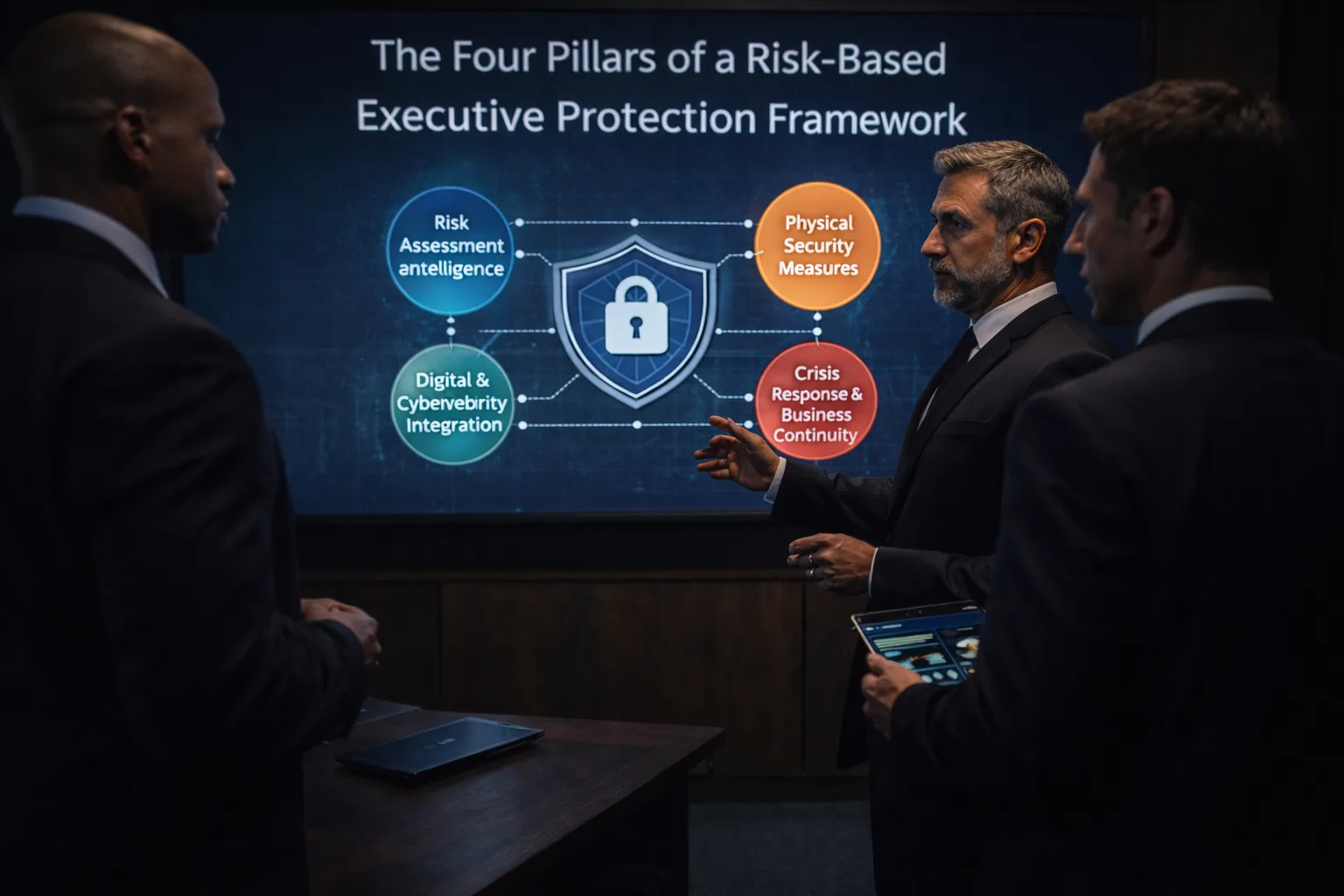
The Four Pillars of a Risk-Based Executive Protection Framework
Executive protection rests on four interconnected pillars that form a complete protective ecosystem.
1. Risk Assessment and Intelligence
Every effective protection program begins with understanding the threat landscape. Risk assessment is a continuous process that evolves with changing circumstances.
Modern threat assessments analyze industry risks, digital footprints, geopolitical factors, and insider threats—while identifying where these risks intersect.
Intelligence gathering includes monitoring open-source data, social media, dark web activity, and geopolitical developments to detect early warning signs.
2. Physical Security Measures
Physical security extends beyond guards and access control. It includes residential protection, secure travel planning, and controlled access to corporate facilities.
Residential security involves perimeter protection, surveillance systems, visitor protocols, and emergency response planning.
Travel security includes route planning, risk assessments, local coordination, and secure communications.
3. Digital and Cybersecurity Integration
Executives operate in a hyperconnected environment where digital exposure can translate into physical risk.
Protection includes secure communications, VPN usage, device separation, and monitoring of personal data exposure.
Threats often cross domains—such as hacked devices revealing locations or social engineering exposing travel plans—making integration essential.
4. Crisis Response and Business Continuity
Even strong prevention cannot eliminate all risk. Effective crisis response determines outcomes.
Organizations need tested response plans for emergencies, clear communication protocols, and continuity strategies to maintain operations during disruptions.
Building Your Risk-Based Protection Program
Start with a comprehensive risk audit covering executive routines, travel, public exposure, and digital footprint.
Prioritize threats based on likelihood and impact, then build a multidisciplinary team combining physical security, cyber expertise, intelligence, and crisis management.
Implement integrated systems that allow visibility across all domains and train executives and families on security awareness.
The HK Defense Solutions Approach
HK Defense Solutions focuses on integrating cyber, physical, and intelligence capabilities into a unified system.
Each engagement begins with threat mapping, followed by a tailored protection strategy and continuous monitoring.
The goal is seamless coordination, proactive risk reduction, and security that supports executive effectiveness—not restricts it.
Moving Forward with Confidence
Modern threats require modern protection. Reactive, siloed approaches leave critical gaps.
A risk-based executive protection framework builds confidence by ensuring threats are anticipated and managed across all domains.
The question isn’t whether executives face risk—it’s whether your organization is prepared.
Executive Protection Explained: Key Questions
What is executive protection?
Executive protection is a risk management discipline focused on safeguarding leaders by identifying threats, reducing exposure, and coordinating protection across environments.
How is it different from traditional security?
Traditional security is reactive and siloed. Executive protection is proactive, intelligence-led, and integrated.
Why do executives face higher risk today?
Increased visibility, digital exposure, activism, and geopolitical instability create elevated risk.
What does a risk-based framework include?
It integrates intelligence, physical security, cybersecurity, and crisis response into one system.
When should protection be reassessed?
After leadership changes, expansion, incidents, or shifts in the threat environment.
Take the Next Step in Executive Protection
Don’t wait for an incident to expose vulnerabilities. HK Defense Solutions offers a confidential security assessment to evaluate your current posture.
The assessment covers physical security, digital exposure, intelligence capabilities, and crisis readiness—providing a clear roadmap for improvement.
Contact us to strengthen your executive protection strategy.