
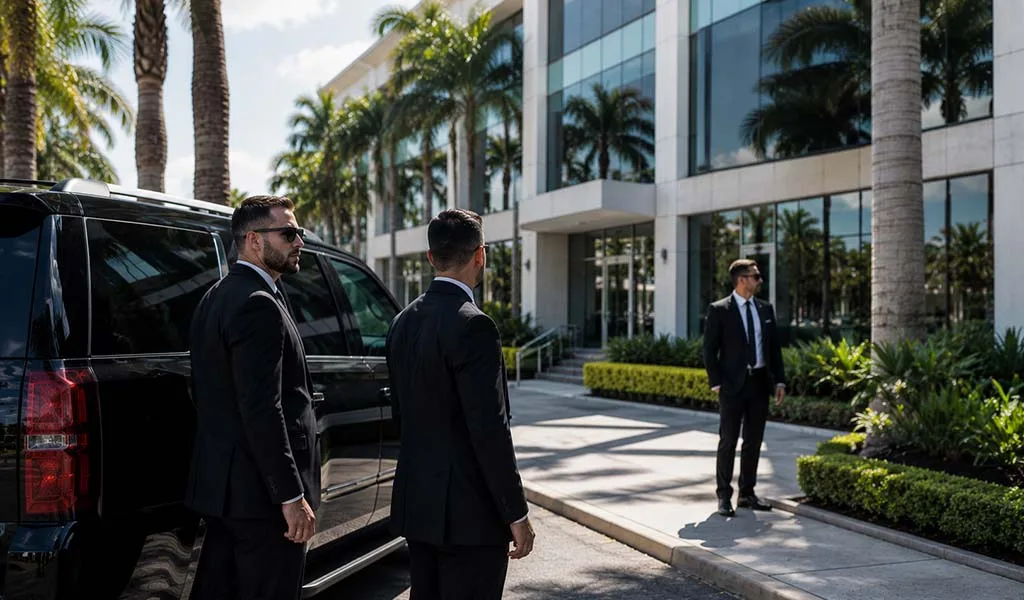
The December 2024 murder of UnitedHealthcare CEO Brian Thompson permanently changed corporate governance expectations around executive protection. Prior to that incident, EP was frequently treated as a discretionary perk. After it, boards, insurers, and institutional investors treat EP as a governance obligation.
For Boca Raton’s concentration of corporate executives, financial services principals, and family office leadership, that shift matters directly. Our own coverage on executive protection in Boca Raton covers the specific architecture the current environment requires.
The Boca profile
Boca Raton is not a residential-only luxury market like Palm Beach Island or a trophy estate market like Manalapan. It is a corporate-adjacent luxury market. The Boca Raton Resort & Club, Royal Palm Yacht & Country Club, St. Andrews Country Club, and the broader corporate corridor create a distinct concentration profile. The corporate leadership living in the area often runs operations that headquarter elsewhere but that produce visible executive travel, board meetings, and public appearances originating from Boca.
That profile produces a specific exposure category. The executives residing in Boca are frequently public figures within their industries. Their compensation packages are documented. Their addresses can be inferred from property records. Their travel patterns can be studied from public event schedules and industry conference calendars.
Prior to December 2024, that exposure was treated as background noise. After December 2024, corporate governance requirements have started treating it as material risk.

The insider threat and third-party access reality
Alongside the direct executive protection dimension, the post-Thompson environment has drawn attention to the insider threat category specifically as it applies to UHNW residential environments.
Recent Verizon DBIR data documents that third-party involvement in breaches has reached nearly half of all incidents, a 60 percent increase from the prior year. That statistic is enterprise-focused, but the pattern applies directly to UHNW residential environments where third-party access is extensive and often less controlled than in comparable enterprise contexts.
A typical Boca executive residence engages 15-30 vendor companies. The insider threat dimension is not theoretical. Family offices supporting Boca executives are increasingly targeted by AI-enabled social engineering that exploits the trust patterns and less-formal authentication typical in family office operations. Voice cloning attacks against wire transfer authorization. Deepfake video communications from purported principals. BEC attacks that manipulate vendor payment routing.
Our detailed coverage on family office security blind spots in 2026 addresses the specific vulnerability categories that Boca family offices routinely leave open.
What corporate governance now expects
The specific shift Thompson’s killing accelerated is the treatment of executive protection as a documented, governance-visible function rather than an informal arrangement. Corporate boards now expect EP programs that satisfy several requirements simultaneously.
Documented threat assessments that establish the basis for the protection program. Structured methodology that can be reviewed by risk committees, insurers, and regulators. Reporting frameworks that demonstrate ongoing effectiveness and cost management. Accountability standards that mirror the governance discipline applied to other material corporate risks.
For a Boca executive whose personal security has historically been treated as a private matter, the post-Thompson environment increasingly requires that the personal security architecture align with corporate governance expectations. Our coverage on why boards must prioritize CEO protection addresses the governance dimension specifically.
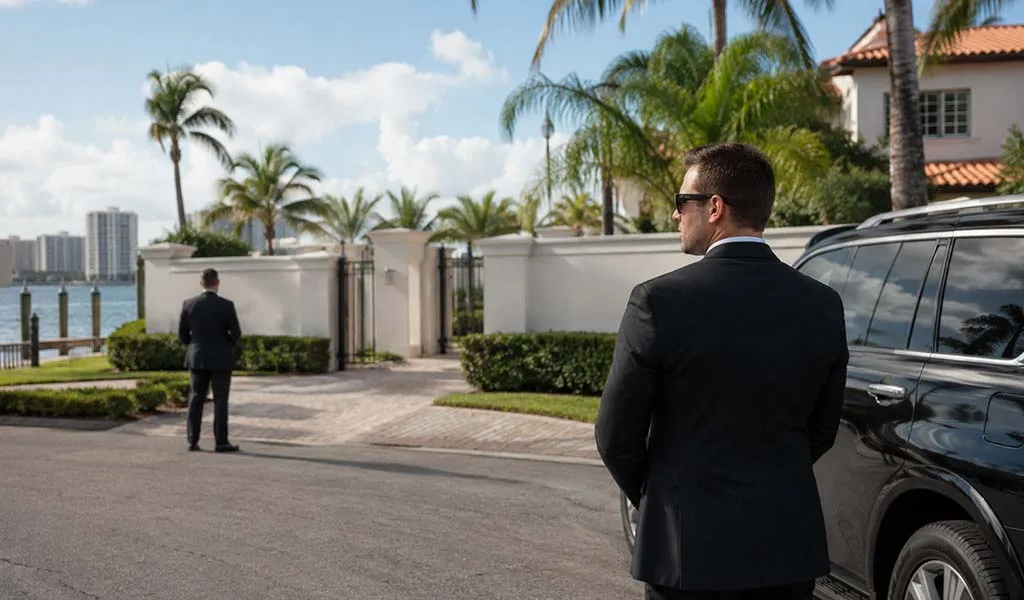
The Palm Beach Post's ongoing coverage
The Palm Beach Post’s business coverage has documented the concentration shift toward Boca Raton as a specific center of family office and financial services operations. Rachelle Blair-Frasier’s coverage of security industry developments at Security Magazine provides the industry-context reporting on how corporate security departments have adapted post-Thompson.
What to do now
For Boca corporate executives and family office principals, three practical priorities.
Assess whether your current residential-only security architecture matches the post-Thompson governance environment. If your corporate role requires executive protection but your current arrangement is residential-focused only, the gap will be flagged in the next board risk review whether you initiate the review or not.
Address the insider threat and third-party access reality at your residence. The 48 percent DBIR statistic translates directly to the residential context. Structured vendor vetting, access compartmentalization, and off-boarding protocols close the specific gap that most residential programs leave open.
Integrate your personal security architecture with your corporate governance framework.
Ready to Take the Next Step?
Download the Board-Level Risk & Continuity Oversight Checklist.
The 15-point framework specifically designed for board-level review of executive protection.
Read next:
— the specific architecture for Boca residential exposure alongside corporate coverage.
HK Defense Solutions provides executive protection, corporate security integration, and residential security for Boca Raton corporate executives. Licensed Florida Class B, D, and G. Contact our team.