
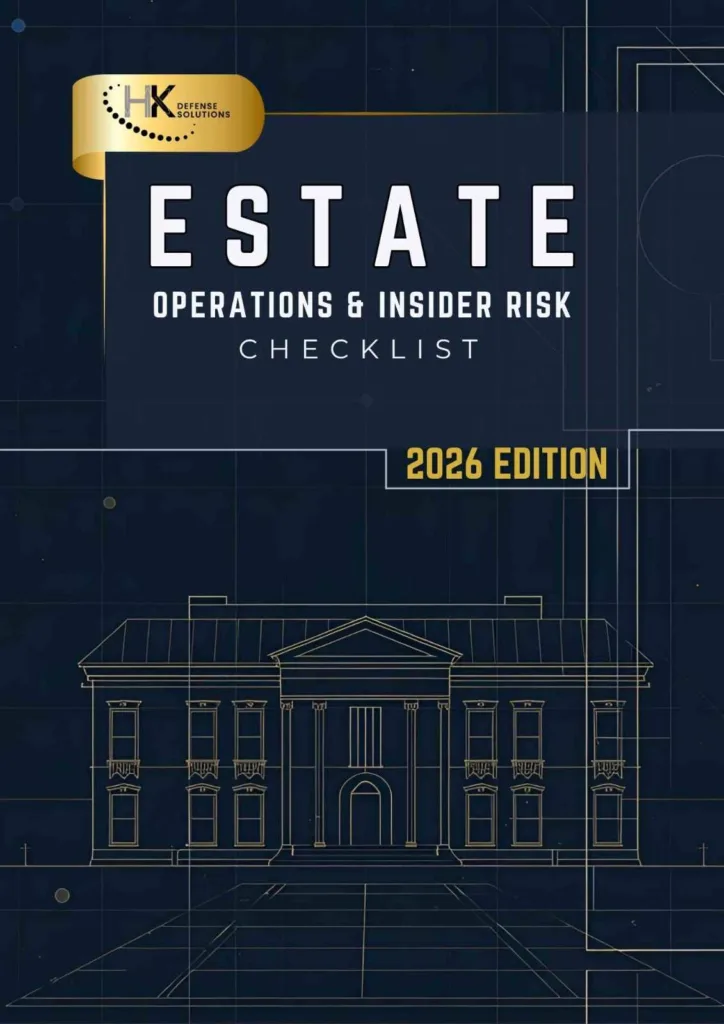
Estate Operations & Insider Risk
Protect Your Family Office from the Threats Within
Insider Threat Audit
10-point checklist to evaluate your hiring, vetting, and monitoring of household staff, contractors, and inner-circle employees.
Seal Information Leaks
Identify where sensitive family and financial info might be slipping out – from casual conversations to unsecured devices – and how to plug those leaks.
Access & Privilege Control
Ensure the right people (and only the right people) have keys to your “kingdom” – physical keys, digital passwords, alarm codes, financial accounts, etc.
Behavioral Red Flags
Learn the subtle warning signs of disgruntled or compromised insiders, and how to establish a culture that deters malicious behavior.
Immediate Actions
Get quick, actionable steps to strengthen your estate’s internal defenses today. (Used by top family offices to safeguard generational wealth and privacy.)
Download Your Free Checklist
When Home Becomes the Front Line.
For ultra-affluent families, a fortress of gates, cameras, and alarms can create a comforting sense of security.
But what if the real threat walks through those gates every morning with a smile and a uniform?
The call, as they say, is coming from inside the house.
Statistics show over 60% of security breaches and incidents originate from someone on the inside – whether through malice or mistake.
Just imagine: a trusted personal assistant leaks your travel itinerary to impress a friend, a long-time driver innocently posts a photo of your car collection (revealing your location), or a disgruntled estate manager sells access codes to criminals.
These aren’t James Bond scenarios; they are real stories that happen to real families.
Consider a Quick Reality Check
- Have you ever had a staff member suddenly leave under tense circumstances?
- Do you know if all their access was revoked, truly all of it?
- What about the garage door PIN they set, or the secondary phone they had linked to your security camera app?
- When was the last time passwords were changed for contractors who set up your home network?
Every estate has soft underbelly points like these. Our Estate Operations & Insider Risk Checklist will help you find them before someone with bad intentions does.
The Betrayal You Never See Coming
The Insider Malware Case
The Trusted Connection
The Lesson ?
High-profile individuals and families are targets, and adversaries will often use your trust network against you.
Areas Families Often Miss
Perhaps you do background checks when hiring household staff or executives for the family office. But are they truly comprehensive and ongoing? We’ve seen families hire a charming estate manager only to learn later he had quiet financial troubles – a potential blackmail risk. Our checklist helps you review your vetting processes and institute periodic re-screenings or lifestyle audits for those with sensitive roles.
Over the years, trust builds and so do privileges. The IT guy ends up with access to the home safe code because he was helping to set up a security system. The nanny knows the alarm password and Wi-Fi password. The family office junior analyst has read-only access to accounts, which turns into edit access during a busy period – and never reverts. Access accumulates like snow piling on a roof; eventually, something can collapse. Are you regularly reviewing who can access what? The checklist will prompt you to assess and revoke unnecessary privileges.
Ironically, the richest families can suffer from the poorest internal communication when it comes to security. Does your household security team communicate with your corporate security or IT teams? If your executive protection detail notices a suspicious new friend hanging around your son or daughter, does anyone inform the family office or HR to quietly look into it? When pieces of information don’t come together, patterns are missed. Many breaches are “symptoms of fragmentation” – bits of concerning data that no one connected. We ensure you’re asking whether your systems (and people) talk to each other.
Is there a culture of unquestioned trust in your household and office? Families are close-knit, and loyal staff feel like family – which is wonderful, but can lead to blind spots. If an employee starts acting erratically or seems suddenly flush with cash, would anyone call it out? Often, small red flags are ignored out of respect or not wanting to pry. We encourage families to foster a culture where security isn’t taboo. One client implemented an anonymous “if you see something, say something” channel within his estate staff – and caught a vendor regularly tailgating into the property without proper ID, a lapse that could have been exploited.
John Hamilton’s Take
Precision of a Mission, Privacy of a Family
HKDS’s founder John Hamilton has a very personal understanding of insider risk. In special ops, everyone is vetted to the extreme; lives depend on absolute trust and competence. When John transitioned to protecting high-net-worth families, he was shocked at how many private teams were running on a “good vibes and loyalty” system rather than strict protocol.
John built HKDS’s Insider Threat Program to bring military-grade rigor to family operations, but in a discreet, respectful way. It’s all about architecture over optics: real structures of trust and verification, rather than assuming everyone is an angel.
“Trust, but verify, and then verify again.”
One of HKDS’s flagship cases involved a family facing subtle but escalating issues: confidential info was leaking to tabloids, valuables were missing, and there were whispers of a revenge-minded former employee.
Our team implemented a converged insider threat strategy: cyber analysts monitored dark web and social media for chatter about the family, finding a disgruntled ex-nanny trying to sell a story.
Simultaneously, we quietly audited the estate’s access logs and found an active keycode belonging to a terminated driver. We also installed a few strategic “tripwire” documents (fake info to see if it would leak) within the family office IT system. Within weeks, we identified a current staff member who took the bait.
It was a painful revelation for the family, but a necessary one – they removed the bad actor before any harm could come. The transformation was palpable: the family went from feeling paranoid in their own home to knowing they had regained control and could actually trust their inner circle again (because it had been properly vetted and secured).
How This Checklist Helps You
You shouldn’t have to live in suspicion, but you also shouldn’t live in ignorance.
The Estate Operations & Insider Risk Checklist will empower you to:
Gauge Your Insider Risk Posture
Quickly assess whether you have safeguards in place to detect and deter insider threats, from gossip to deliberate sabotage.
Strengthen Confidentiality
Confirm NDAs and privacy policies are current and enforced. Prevent forgotten agreements and reinforce trust boundaries.
Review Estate Protocols
Ensure exits, access removals, and new hire onboarding are airtight, no loose ends or lingering privileges.
Improve Staff Security Culture
Verify everyone knows how to report and respond to incidents — so even household staff act fast when something feels off.
Protect Personal & Family Data
Identify any unprotected data sources, like paper files, open documents, or unsecured Wi-Fi. Strengthening these safeguards protects you from both insider risks and accidental leaks.
Don't Wait for a Betrayal or a Scare
Most families only act after a breach or betrayal. You’re choosing foresight over hindsight — protecting both your assets and your home’s trust.
Get your Estate Insider Risk Checklist now.
It’s free, confidential, and built to safeguard your inner circle before issues arise.