In May 2025, West Palm Beach Police arrested a man they described as a serial burglar and attributed more than a dozen successful or attempted break-ins to him across the South End, El Cid, and Villages neighborhoods. He targeted both homes and vehicles. His preferred entry method was simple: unlocked doors. Among the items stolen were firearms.
That case was notable not because the tactics were sophisticated — they weren’t — but because the pattern illustrates the baseline threat that residential security in West Palm Beach needs to address before you even get to the more complex scenarios.
Most residential security programs are designed for a specific threat model: someone physically attempting to breach a locked perimeter. Alarms, cameras, door locks, motion sensors — all of it assumes that the adversary is going to try to break in. But across the majority of residential burglary cases in Palm Beach County, entry doesn’t require breaking anything. The door is unlocked. The gate is open. The window is ajar. The garage door opener was left in an unlocked vehicle.
That’s the baseline. What’s changing is everything above it.
The evolution from opportunistic to intelligence-driven
The serial burglar case in West Palm Beach was opportunistic crime. Walk through a neighborhood, try doors, take what’s available. This is the threat model most residential security systems are built around, and it’s the one most alarm companies sell protection against.
But Palm Beach County has also seen a documented pattern of intelligence-driven residential targeting that operates on an entirely different level. In 2024 and 2025, coordinated operations targeting UHNW residences across South Florida used weeks of pre-operation surveillance, social media intelligence collection, and identification of family schedules through public records and digital footprint analysis.
The FBI’s Organized Theft Groups investigation has tracked crews operating across multiple states who time their operations to coincide with confirmed absences — often verified through social media posts from family members, staff, or event organizers. These aren’t opportunists trying unlocked doors. These are operations with reconnaissance phases, target selection criteria, and execution windows planned around specific intelligence.
The gap between these two threat models is where most residential security programs in West Palm Beach fail. They’re built to stop the opportunist. They have no capability to detect, deter, or respond to the intelligence-driven operation.
What the neighborhoods tell us
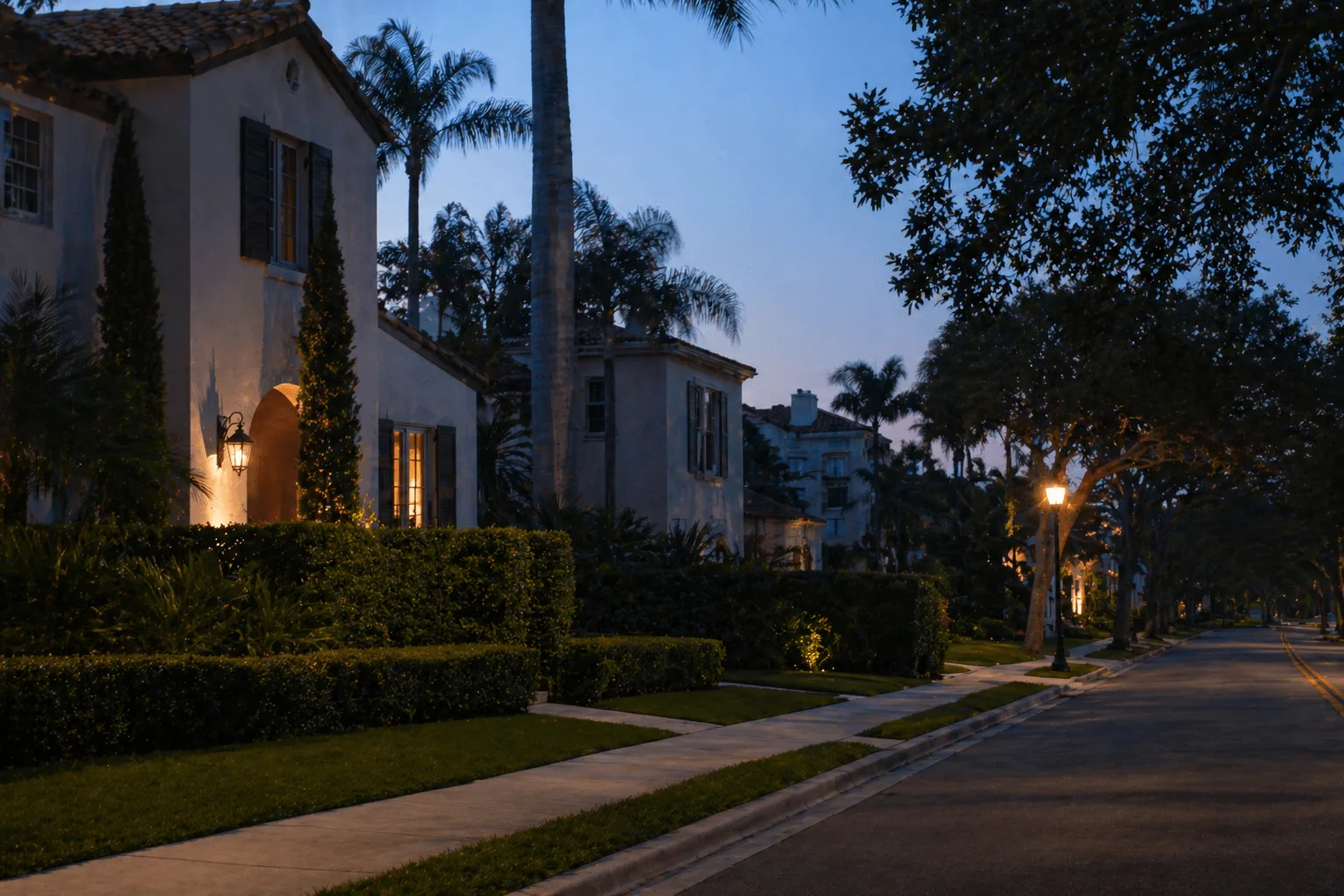
The three neighborhoods referenced in the serial burglar case — South End, El Cid, and Villages — represent a cross-section of West Palm Beach’s residential market. South End includes some of the city’s most desirable historic homes. El Cid contains a mix of restored historic properties and newer luxury construction. The Villages area includes suburban-style residential development.
Each has different security characteristics. South End properties are close together with limited perimeter options. El Cid properties often have larger lots with more exterior exposure. Villages properties tend to have standardized layouts with common access points.
A security program designed for one of these neighborhoods wouldn’t necessarily work in another. The threat patterns are different. The property types create different vulnerabilities. The population density changes the response dynamics. A mobile patrol route that makes sense in Villages doesn’t make sense in El Cid. Guard deployment that works for a South End property needs a different posture for a waterfront estate on Flagler Drive.
This is what we mean when we talk about threat-informed security. The protection has to match the environment, the property, and the specific threat pattern — not a standardized package applied to every residential client.
The seasonal factor
Palm Beach County’s seasonal population cycle creates a specific burglary pattern that compounds both the opportunistic and intelligence-driven threats. During the winter season (October through April), properties are occupied, staffed, and active. During the off-season (May through September), a significant percentage of luxury properties are vacant — owners are at their Hamptons, Nantucket, Aspen, or European residences.
The transition periods are the highest-risk windows. April and May, when seasonal residents are departing, create a predictable wave of vacancy that anyone monitoring the neighborhood can observe. The landscaping crew that shows up weekly. The pool service that continues. The mail that accumulates. The lights that stop turning on at night. All of it signals an empty property.
Off-season security for seasonal properties is a distinct service requirement. It needs to include regular mobile patrol with active property checks, alarm monitoring that actually produces a response, periodic interior inspections to verify that nothing has been disturbed, and coordination with the property owner or estate manager to maintain the appearance of occupancy.
What a comprehensive program addresses
Residential security in West Palm Beach in 2026 needs to address the full threat spectrum — from the opportunist trying unlocked doors to the intelligence-driven operation that has been watching the property for weeks.
At the baseline level: physical hardening of access points, alarm systems with verified response, exterior lighting and camera coverage that create detection capability, and the basic discipline of locking doors, closing garages, and securing vehicles.
At the intermediate level: mobile patrol services that conduct active property checks rather than drive-by visits, guard deployment for properties that warrant continuous coverage, and staff vetting protocols that address the insider risk created by housekeepers, landscapers, pool services, and other personnel with regular access.
At the advanced level: digital exposure management that reduces the amount of targetable information available about the property and its owners, counter-surveillance awareness for properties that may be under observation, social media protocols for family members and staff, and coordination across multiple properties to ensure that the security posture adjusts automatically when the family moves between residences.
Most security companies in West Palm Beach offer the baseline. Some offer the intermediate level. Almost none offer the advanced level — because it requires capabilities (OSINT auditing, counter-surveillance, multi-property coordination, insider risk management) that guard companies were never built to provide.
About HKDS
HK Defense Solutions is headquartered in West Palm Beach at 1500 N Florida Mango Rd. We provide residential and estate security services across West Palm Beach, Palm Beach Island, Jupiter, Wellington, Manalapan, Boca Raton, and the full Palm Beach County market. Our programs address the full threat spectrum — from baseline physical security through advanced digital exposure and counter-surveillance capabilities.
Founded by a 12-year U.S. Air Force special operations veteran. Licensed Florida Class B, D, and G.
For an Estate Security Assessment covering your property, contact us at