ESTATE & RESIDENTIAL SECURITY
Your Estate Is a Living System.
Most Security Treats It Like a Locked Door.
A private estate is not a building. It’s an operational environment.
Staff rotate in and out daily. Contractors access the grounds on schedules nobody audits. Family members move between multiple properties across time zones. Smart home devices connect to networks that haven’t been segmented since installation. Former employees still know the gate code from the time they were hired.
Traditional residential security treats all of this like a lock on a door.
HK Defense Solutions treats it like a system that needs architecture, intelligence, and constant adjustment.
We provide estate security across Palm Beach Island, Jupiter, Jupiter Island, Wellington, Manalapan, Greenwich, Manhattan, the Hamptons, Miami Beach, Beverly Hills, and wherever else our clients maintain residences.
Built for the People Whose Homes Are Targets
Our founder served 12 years in U.S. Air Force special operations, including the design of layered defense systems for forward operating bases where the threat was constant and real. Our estate security personnel include former military operators, federal protective service professionals, and intelligence-trained security specialists. We conduct ongoing training in physical security, counter-surveillance, threat recognition, and the specific patterns that distinguish UHNW residential protection from conventional home security.
Our clients include families with wealth concentrations that make them targets regardless of what they do, and public figures whose visibility makes their homes subject to surveillance they’re often not even aware of. We operate under NDA in every engagement. You won’t find our clients on our website.
What Estate Security Actually Requires
The foundation of estate security is the perimeter — but most luxury properties have perimeters that were designed for aesthetics rather than defense. High hedges that block visibility from the street also block visibility from inside. Decorative gates that open for anyone on a list. Camera systems installed at angles that favor visual coverage over detection. Property lines that include beach or water access with no marine-side protection at all.
We assess and upgrade perimeter defense systems across all of these vectors. Physical barriers, lighting, sensor networks, camera coverage, and access control integration. For waterfront properties in Palm Beach, Jupiter Island, Miami Beach, and the Hamptons, this includes marine-side surveillance and response planning that most residential security companies don’t offer. For estates with significant exterior acreage in Wellington, Greenwich, and equivalent markets, it includes extended perimeter detection and response protocols for areas well beyond the primary residence.
We provide continuous or part-time guard deployment based on the actual risk profile of the property. For full-time UHNW residences, we offer 24/7 protective staffing with multiple shift rotations and supervisory oversight. For seasonal properties, we provide coverage during occupancy and transition to enhanced vacancy protocols when the family is away.
The difference between our protective staffing and a standard residential guard service is training and integration. Our personnel are not hourly labor filling posts. They’re protective professionals who understand household operations, family dynamics, staff management, and the coordination requirements of a full estate security program. They work with household managers, executive protection details, travel teams, and family office operations to maintain a unified security posture.
The highest-probability threat on most UHNW estates isn’t external. It’s someone with authorized access. We build comprehensive vetting and management protocols for household staff, covering initial background investigation, periodic re-screening, device policies, social media restrictions, NDAs, and structured off-boarding procedures for when staff departures occur.
This matters because the standard approach to household staffing is catastrophically inadequate for the threat environment we operate in. A one-time background check at hiring tells you whether someone had a criminal record on the day they were hired. It tells you nothing about financial pressures that developed six months later, social connections that emerged over time, or the personal devices they carry through your property every day. A comprehensive insider risk program addresses all of this.
Families who maintain residences in Palm Beach, the Hamptons, Manhattan, Aspen, Greenwich, and European locations rarely have unified security protocols across their properties. Each residence typically operates with a different alarm monitoring company, different guard services, different access control systems, and different staff vetting standards. The weakest property becomes the entry point for the entire family.
We integrate security operations across all properties in a family’s portfolio. Unified threat intelligence, coordinated protocols, consistent standards, and real-time communication between the teams at each residence. When the family moves from one property to another, the security posture transitions automatically. When a threat develops at one property, every other property is notified and adjusts accordingly.
Most luxury estates built or renovated in the last five years contain between 40 and 100 connected devices. Smart locks, lighting systems, climate control, security cameras, video intercoms, motorized shades, whole-home audio, irrigation systems, pool controllers, and voice assistants. Every one of these devices is a potential vulnerability — and in most estate assessments we conduct, the network architecture securing them is either nonexistent or improperly configured.
We audit and remediate network architecture for connected luxury estates. Network segmentation, device inventory, credential management, firmware oversight, and integration between physical security systems and the networks they depend on. The goal is to ensure that the camera system protecting your property isn’t sitting on the same network as your children’s gaming console — and that a vulnerability in any connected device cannot compromise the physical security infrastructure.
In Palm Beach County, the Hamptons, Beverly Hills, and several other UHNW markets, drone incursions over private residential properties are now a weekly occurrence. Most estate security programs have no capability to detect, document, or respond to these events. We provide counter-drone detection, documentation protocols, and legal response coordination for properties where this threat is active.
We also provide counter-surveillance operations for residences where principals believe — or we have reason to believe — that the property is being monitored. Physical surveillance, signal interception, and public-source observation are all components of surveillance operations that target high-profile residences. Detecting them requires capabilities that conventional residential security doesn’t include.
What Is Actually Happening to UHNW Residences in 2026
The threat landscape for luxury residences has changed more in the past three years than in the previous twenty. The firms protecting UHNW estates today are either adapting to this reality or being left behind by it.

Here’s what we’re seeing in the field across Palm Beach, the Hamptons, Beverly Hills, Greenwich, and the other markets where we operate.
Coordinated burglary operations
Operations targeting luxury homes have become increasingly organized and intelligence-driven. In 2024 and 2025, high-profile incidents across South Florida, Los Angeles, and the Northeast revealed that multiple criminal organizations were using extensive pre-operation surveillance to identify and target UHNW properties. These operations included weeks of observation, social media intelligence collection, identification of family schedules through public records and digital footprint analysis, and in several documented cases, insider cooperation from household staff or contractors. The FBI’s Organized Theft Groups investigation has tracked crews operating across multiple states, targeting residences during known absences often confirmed through social media posts from family members.
Smart home exploitation is not a theoretical risk.
In 2023, a widely reported vulnerability in a major residential camera manufacturer’s product line allowed remote access using default credentials. Researchers subsequently demonstrated similar vulnerabilities in smart locks, alarm panels, and integrated home automation systems from multiple vendors. The estates most at risk are the ones where the AV integrator installed the system, configured the defaults, and never returned — which describes the majority of luxury installations we assess.
Data broker exposure has weaponized home addresses.
Property records in Florida, New York, California, and most other states are public information. Combined with commercial data broker services, the complete address, property layout, purchase history, and ownership structure for nearly any UHNW residence can be obtained in minutes for under $50. Multi-state legislation has begun addressing this for certain protected categories — judges, law enforcement, reproductive healthcare workers — but private individuals, including the wealthiest families in America, remain fully exposed.
Drone surveillance over private properties
Has escalated from occasional incidents to a routine occurrence in UHNW enclaves. In Palm Beach County alone, private security firms report multiple drone sightings per week during peak season. Most incidents involve non-hostile drones conducting what appears to be surveillance or photography, but the distinction between surveillance and hostile intent is often impossible to determine in real time. Counter-drone capabilities are now standard requirements for estate security in these markets.
Insider Cooperation as the Primary Threat Vector
Insider cooperation remains the primary enabler of serious property crimes against UHNW residences. In multiple documented cases across 2023-2025, household staff, former employees, contractors, or service personnel provided intelligence that enabled burglary, robbery, and home invasion operations. The common factor is almost always a vetting and management failure — either at the initial hiring stage, during the employment relationship, or at termination. Estate security programs that don’t integrate insider risk management into their operational model are protecting against an incomplete threat picture.
Staff digital hygiene creates exposure that nobody addresses.
The housekeeper’s phone connects to the estate Wi-Fi and backs up family photos to a personal cloud. The driver posts vehicle photos on social media, sometimes with recognizable backgrounds. The personal assistant’s LinkedIn profile names the family office and the principal. The tutor’s Instagram shows children in identifiable locations. None of these people intend to create vulnerabilities. They all do.
The entire operational environment around it.

Why HKDS Builds Estate Security Differently
When John Hamilton transitioned out of U.S. Air Force special operations after 12 years of service, he found himself in an industry that had never seriously applied the lessons of military security planning to private residential protection. The guard at the gate. The alarm on the wall. The camera above the door. These were treated as complete solutions when they were actually starting points.
In his military career, Hamilton built security postures for forward operating bases in Iraq, designed defense systems for Marine and Army divisions, and led security for crash sites and sensitive locations in environments where complacency killed people. Every one of those operations started with intelligence. What’s the threat? Who’s operating in the area? What patterns are we creating that could be exploited? What’s our response if the threat develops? None of it assumed anything.
That’s the standard he brought to HKDS. Every estate we protect is assessed the way a military installation is assessed — honestly, thoroughly, and with the assumption that something will eventually be tested. The goal isn’t to react well when something happens. The goal is to ensure nothing happens in the first place.
Estate Security Coverage Areas
- Palm Beach Island, West Palm Beach, Manalapan, Gulf Stream
- Jupiter, Jupiter Island, Tequesta, Juno Beach, Jupiter Inlet
- Wellington, Royal Palm Beach, Loxahatchee
- Boca Raton, Delray Beach, Highland Beach, Ocean Ridge
- Miami Beach, Fisher Island, Star Island, Indian Creek, Bal Harbour, Coral Gables
- Fort Lauderdale, Lighthouse Point, Hillsboro Beach
- Manhattan and all New York City boroughs
- The Hamptons: East Hampton, Southampton, Bridgehampton, Sagaponack, Water Mill
- Greenwich, Darien, New Canaan, Westport, and the Fairfield County Gold Coast
- Westchester County estate markets
- Martha’s Vineyard and Nantucket seasonal operations
- Beverly Hills, Bel Air, Holmby Hills, Pacific Palisades, Malibu
- Coverage available for additional markets including Aspen, Jackson Hole, and international residences
What Working With HKDS on Estate Security Looks Like
You stop discovering vulnerabilities by accident. You stop learning that the former housekeeper still had the gate code because she mentioned it to a friend. You stop finding out that the landscaping crew has been photographing the interior during maintenance visits. You stop wondering whether your alarm system is actually connected to anyone who would respond.
Instead, you get a comprehensive security posture that addresses every layer of risk simultaneously. Physical perimeter. Guard deployment. Staff vetting. Digital exposure. Network security. Multi-property coordination. Response protocols. And an operational framework that adjusts as conditions change — not a static plan that was written once and forgotten.
You also get documentation you can actually use. Incident reports that mean something. Briefings that tell you what you need to know without burying the signal in noise. And a relationship with a firm that will tell you the truth about what you actually need — even when the truth is that you’re currently spending money on services that aren’t giving you what you thought you were buying.
Start With a Checklist or a Call
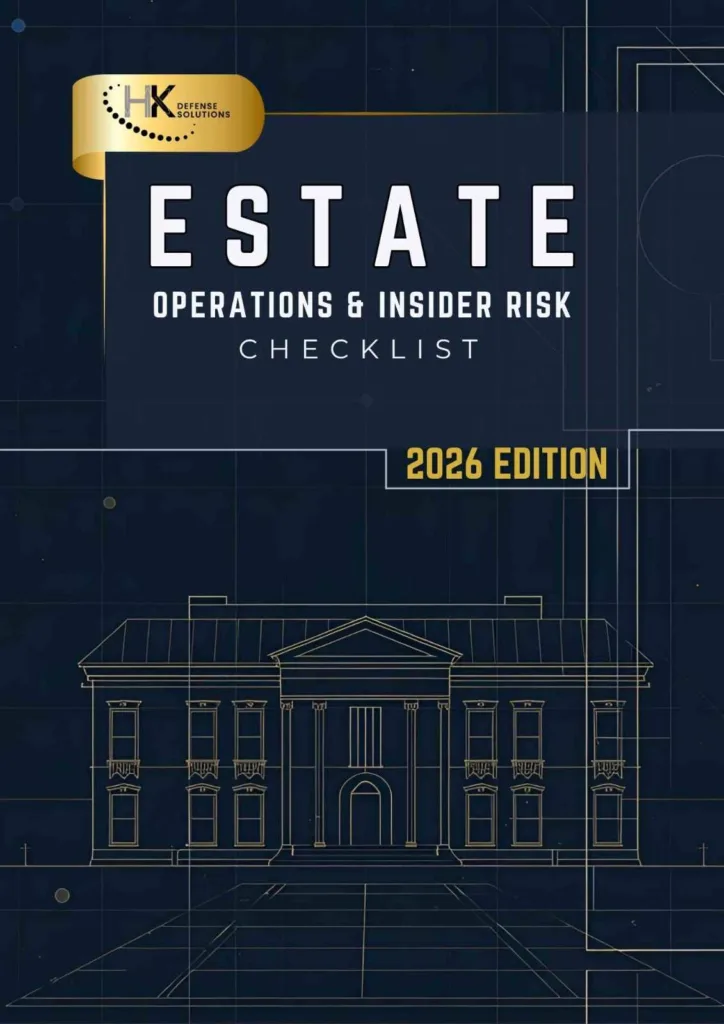
A 15-point framework built for estate managers, family office leaders, and UHNW homeowners. Covers physical security, staff protocols, smart home vulnerabilities, contractor management, and multi-property coordination. Identifies the specific blind spots we find in nearly every assessment — including the ones that feel handled but aren’t.
Free. Confidential. Instant download.
Request an Estate Security Assessment